Nathan Hale was 21 years old when the British hanged him as a spy in 1776. He had been a soldier for barely a year, and a spy for a little over two weeks. He was a failure. He didn't return with a single useful scrap of information. His body was never recovered.
And yet almost 250 years later, his statue stands outside the headquarters of the CIA.
That's the strange thing about Nathan Hale, that he is not remembered for what he did, but how he took it, and a speech, that he may or may not have said: "I only regret that I have but one life to lose for my country."
Who Was Nathan Hale?
Nathan Hale was an American Patriot, soldier and spy during the American Revolutionary War. He was born in Coventry, Connecticut, on June 6, 1755 and died in New York City on September 22, 1776.
In 1985, Connecticut officially declared him the state hero, and has named schools, forts, ships and even a Navy submarine after him.
But when he volunteered, he wasn't a hero, and he wasn't a legend. He was a young army captain who had been waiting around most of the war, and a former teacher, who had never done any spying before.
Nathan Hale's Family and Early Life in Connecticut
Nathan grew up in a big farming family. His father was Richard Hale, and his mother was Elizabeth Strong.
If his family tree has any interesting branches, it might be his great-grandfather was the Reverend John Hale, who was part of the witch trials in Salem, in 1692. Later on in the family tree, his nephew started a newspaper in Boston, and his grand-nephew Edward Everett Hale, became a famous writer, and spoke against slavery.
In 1769, when Nathan was 14, and his brother Enoch was 16, they were both sent to Yale College, which doesn't seem as surprising back then as it does now.
While at Yale, the brothers were part of the Linonian Society, a student debating club. They studied astronomy, math, literature, and arguments both for, and against slavery. It was the kind of place that taught young men to think deeply, and present their ideas in an interesting way to others.
Nathan graduated with great honors when he was 18, and went back to be a teacher, first in the town of East Haddam, and later in New London, Connecticut.
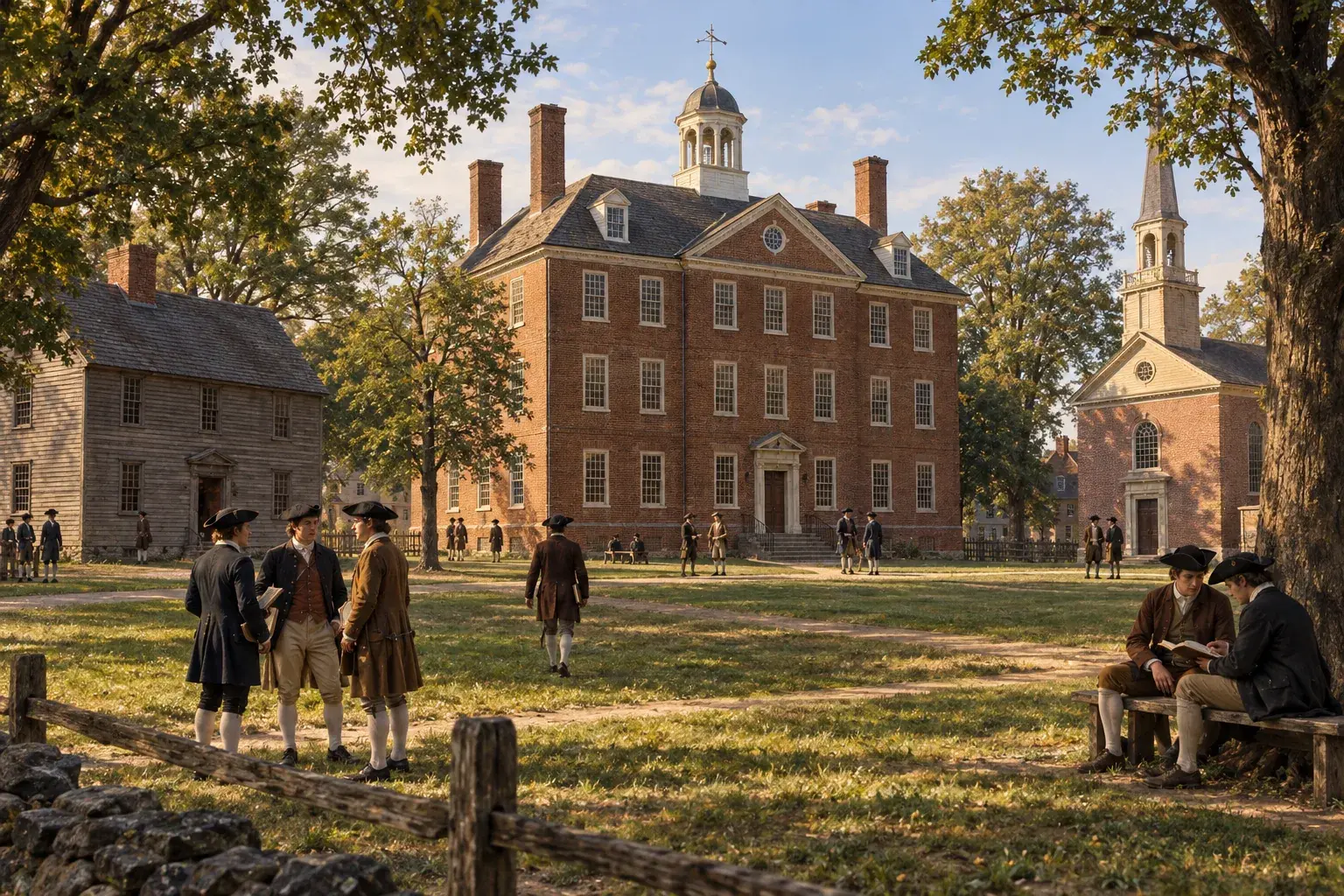
Hale entered Yale at just 14, alongside his older brother Enoch, and graduated with honors at 18 before becoming a schoolteacher.
Benjamin Tallmadge And the Letter That Changed Everything
One of his classmates at Yale, was a younger guy named Benjamin Tallmadge. You'll want to remember that name, as he plays a large part later in the story.
When the Revolutionary War began in 1775, Hale joined a Connecticut militia, and was elected first lieutenant, within five months. But, when Hale's company marched to the Siege of Boston, he was left behind.
Why? No one is really sure. It could be that his teaching contract in New London ran through July 1775, and there wasn't anything he could do about it. Some think, that he just wasn't all that crazy to go fight in the war.
Then, on July 4, 1775, Benjamin Tallmadge, took a trip to Boston, to experience the siege first hand, and then wrote his classmate a letter. In it, he said if he was in his friend's position, he'd choose to serve the wider service, and they should stand for their religion, their country, and their new government.
It was enough to convince Hale. He immediately accepted a commission as a first lieutenant in 7th Connecticut Regiment. In the meantime, he had more promotions, and by the January of 1776, he was a captain of 7th Connecticut, on a commission signed by John Hancock himself.
Knowlton's Rangers and the Battle of Long Island
Later on, Hale joined the Knowlton's Rangers, a unit led by Thomas Knowlton. The Rangers were forward scouts who gathered information about enemy movements, and are often considered to be the first organized intelligence unit in America. This is why the CIA claims Hale as an early ancestor.
In the spring of 1776, the Continental Army crossed the ocean to attack in Manhattan. Everyone knew that the British were going to try to take New York, and that it would be trouble, but no one expected how bad it would be.
In the summer of 1776, the British crushed the Americans at the Battle of Long Island by circling behind the American army and attacking them from the rear. Washington barely escaped with his army off of Long Island, and back into the East River.
Now, with the British poised to take Manhattan, Washington knew he needed more information about where they would land, but he had no idea where they would be. It was a problem, and one that he had a volunteer for.
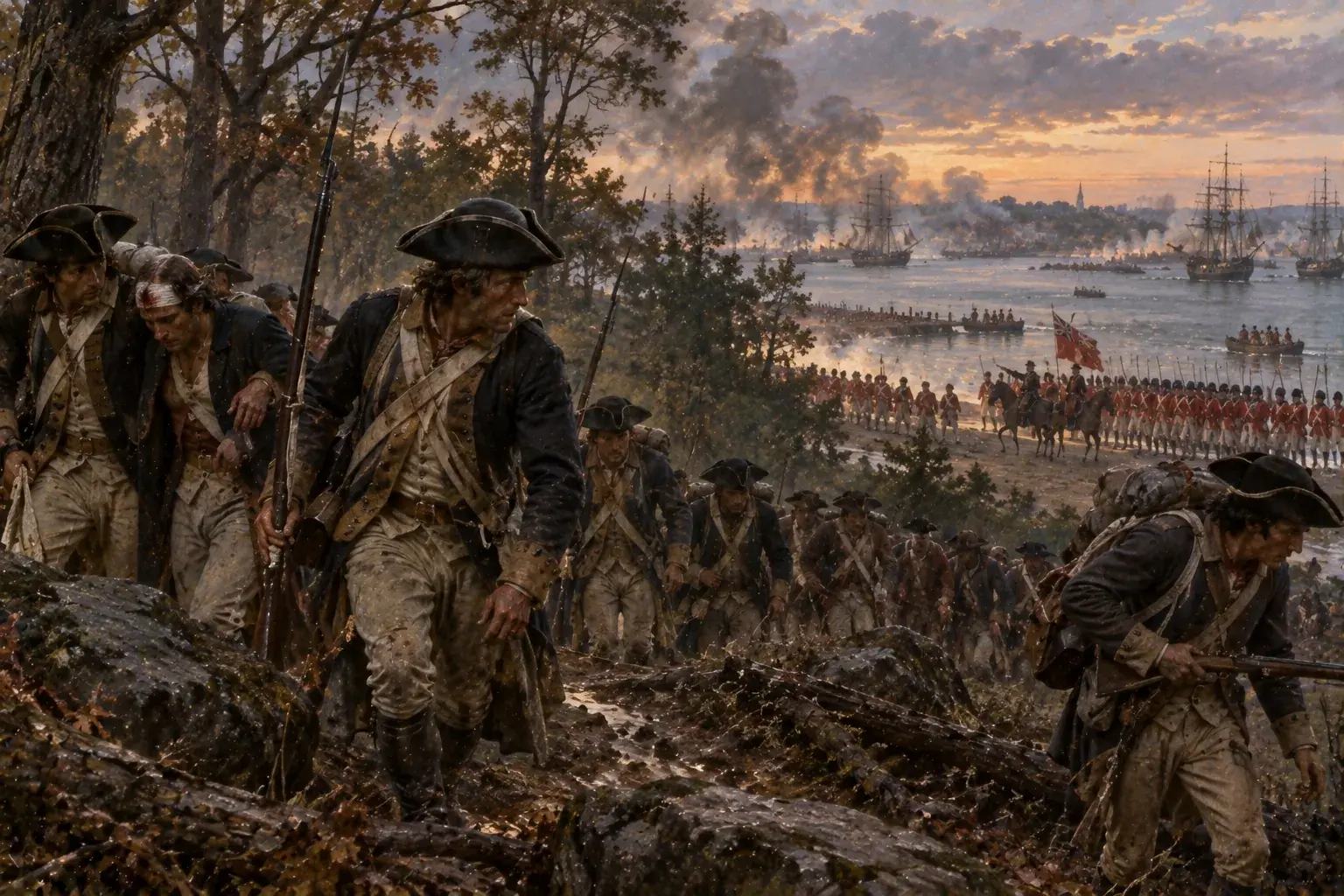
The crushing American defeat at Long Island in August 1776 left Washington desperate for intelligence on the next British move, setting the stage for Hale's mission.
Why Nathan Hale Volunteered To Be A Spy
So, as you can imagine, the first response wasn't a single, eager volunteer.
Spying was considered dishonorable work for a gentleman in the 1700s. Officers were supposed to fight in uniform, in the front lines, and sneaking around in disguise was beneath them. Worse still, even the punishment for a captured spy, wasn't a prisoner exchange, it was hanging by the neck until dead, with no trial.
Hale volunteered, and, according to the traditional account, was the only one to do so. He also knew the risks of being caught, not only for himself, but for his reputation.
He decided to pretend to be a Dutch schoolteacher looking for work, which made sense considering his profession. He was to count the number of troops, their positions, and where they would attack.
Hale's Spy Mission In New York City
On September 8, 1776 he volunteered, and on 12th September, was rowed across Long Island Sound and landed at Huntington, on British held Long Island.
And then, almost immediately, things began to go wrong.
First, Hale had almost no training. Not only was spying new to the American army, there was no one to give him the training. He had a real name, with no cover story, and some say, almost immediately was caught with his Yale diploma, his real name, and his disguise.
Second, there was a change in the environment. On September 15th, shortly after Hale left on his mission, the British captured New York City (at the time, only the tip of Manhattan) and Washington retreated north to Harlem Heights. Any information that Hale might have gathered was becoming less valuable.
Third, and final, was a change in mood. On September 21st, there was a fire that swept over a quarter of lower, or what would become lower, Manhattan. The British, accused the Americans of setting it, and in return the Americans accused the British soldiers of setting it. No one is really sure who did set the fire, but it made many soldiers bitter and angry. And in the moment when Hale was walking around New York City disguised, British soldiers were looking for spies.
How Nathan Hale Was Captured
There are two accounts of how Hale was captured, and they are both debated fiercely by historians.
The better documented account, comes from a Connecticut shopkeeper, named Consider Tiffany, who was loyal to Britain. His personal letters are now owned by the Library of Congress. In it, he describes how Major Robert Rogers of the Queen's Rangers spotted Hale in a tavern. Rogers pretended to be another patriot, and had Hale reveal himself, and Hale was arrested near Flushing Bay in Queens.
If it's true, it would explain the poor decision, as Robert Rogers, was one of the best scouts and raiders in North America.
The other theory is that Hale was betrayed by his cousin, a Loyalist named Samuel Hale, who recognized his disguise.
Either way, the British found physical evidence on Hale, and there are very few arguments to make about that.
Nathan Hale's Last Night And Execution
Hale was brought before British General William Howe, who was staying in Beekman House, a country mansion, in what is now the middle of Manhattan (50th and 51st Streets).
Hale was interrogated and sentenced to be hanged. There was no court, no trial, as it was considered standard practice for a spy out of uniform.
Hale spent his last night in the mansion, either in what is commonly described as a greenhouse or a bedroom, and requested a Bible, and was denied. He then requested a clergyman, and was denied again.
On the morning of September 22, 1776, Hale is said to have been marched up the Post Road to a spot near a tavern called the Dove, at what is now 66th Street and Third Avenue in Manhattan. He was hung there, and he was 21 years old.
Every account agrees that he was remarkably calm. A British officer, Frederick MacKensie wrote in his diary that day that Hale spoke calmly, claimed he believed every good officer owed it to himself to obey orders from up above, and told the onlookers to get ready to die whenever their death should come.
This is the part that made Hale famous, his last words, not the spying, or the capturing, the dying.
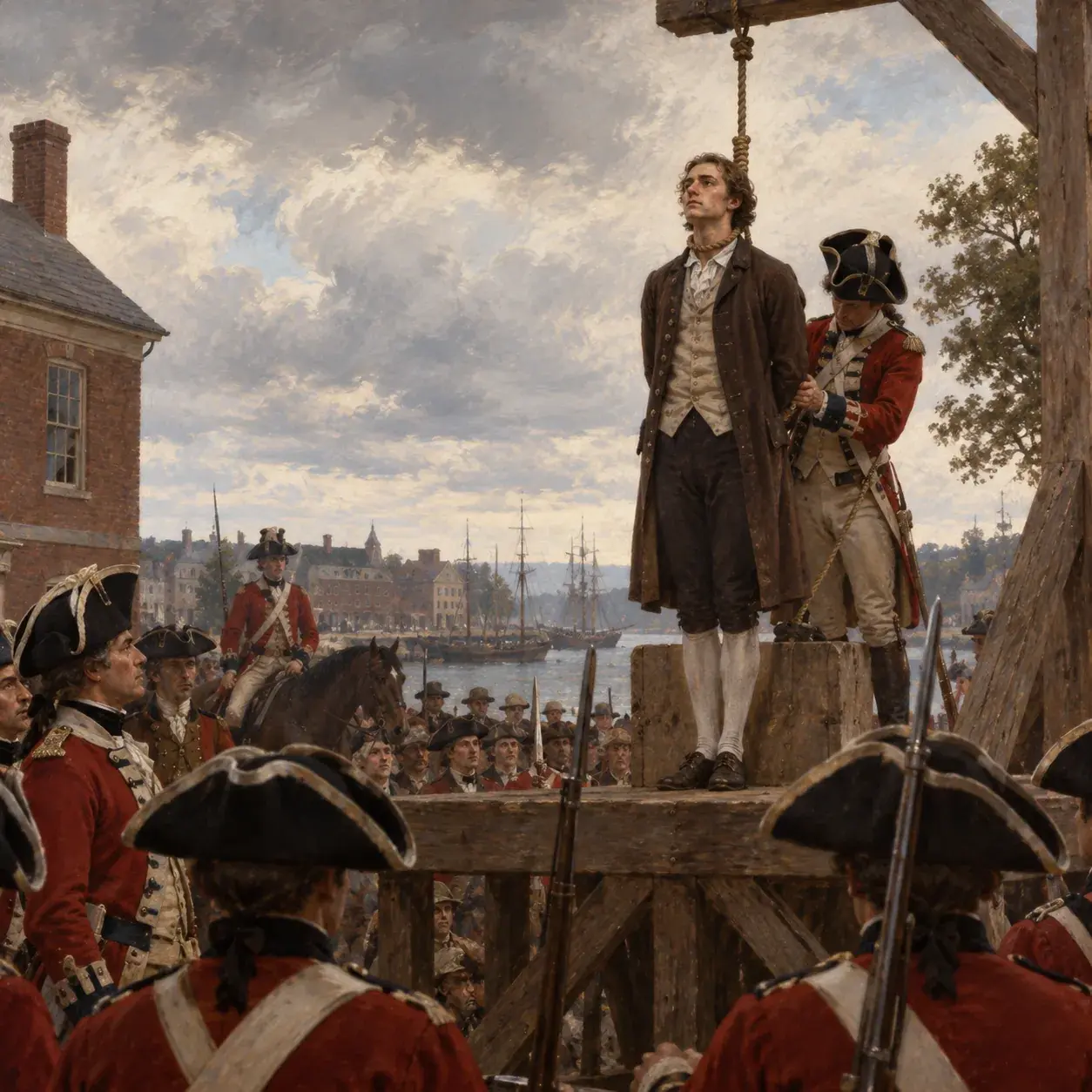
No firsthand sketch of the execution survives; every depiction, including this one, was created long after the fact based on secondhand accounts.
Did Nathan Hale Really Say His Famous Last Words?
There's a problem with his last words, other than the fact that he was likely not paid for them.
No one recorded his last speech, and nobody wrote it down on the spot.
The famous quote comes to us second hand. A British officer named John Montresor was there, and the next morning, under a flag of truce, described the execution to another American officer, William Hull. Years later, Hull would write the conversation down in his memoirs.
According to his version of the conversation, Montresor described Hale as calm and composed, and said he had asked for writing materials, and written two letters, one to his mother, and one to a fellow officer. Then, he was called to the gallows, where he said he only regretted having but one life to lose for his country.
So, it traveled from Hale, to Montresor, to Hull, to a book, written long after the fact. Some historians question the integrity of the words, as they could be lost in translation.
There is also one other thing, that a very popular play of the age, Joseph Addison's Cato, had a very similar line, about how it was a pity we could only die once for our country. The play was extremely popular, and very widely quoted by American Patriots. If Hale had quoted it, he may have been quoting it intentionally, and the audience would have been expected to know what he meant.
What Nathan Hale Probably Actually Said
Historians are fairly certain, that Hale's final speech was probably longer than what we remember.
There are several early accounts, with differing details, that don't contradict each other, but instead add on.
Nathan's Brother, Enoch Hale, wrote in his diary, in October of 1776, after questioning the men who were present, that Hale had said to the crowd, his name, and claimed to be a captain in the Continental Army.
A New England newspaper reported, in 1777, that Hale had given a spirited speech at the gallows, telling the British that they were shedding innocent blood, and that if he had ten thousand lives he would give them all for his country. It's later newspaper version had him saying "I am so far from being dissatisfied with the cause I have espoused," he said, "that were I possessed of ten thousand lives, I would not have given them all in its defense."
If you put it together, you get an entirely different picture of Hale's final minutes, that shows us a young man who spent the last few minutes of his life identifying himself, defending his cause, and accusing his executioners of injustice.
What Did Nathan Hale Look Like?
There's one final surprise about Nathan Hale, other than the fact that he may have been the best dressed man in America at time of his death. No one knows what he looked like. No one painted a portrait of him, during his life or since.
Every statue you've ever seen of him, is an artist's interpretation. The strong, square jawed young man that you see in bronze, was largely invented by sculptor Frederick MacMonnies in the 1890s.
We do however, have one description from a man who knew him. A fellow soldier, Elisha Bostwick described Hale as being only slightly taller than the average man of the time. Fair skin, blue eyes and light blond hair kept short, and a brow, slightly darker. His voice was also described as being sharp, and piercing.
Bostwick later described Hale, as unusually athletic. He remembered watching Hale kick a football over the tops of trees, in New York's Bowery, which was apparently a popular sport at the time.
And lastly, he always visited his sickly comrades in Hale's company, and prayed with them.
This last thing might be the most interesting part about him.
Statues, Schools And Nathan Hale's Legacy
Because Hale's body could not be returned to his family for burial, his family built an empty tomb, (called a cenotaph) in a Coventry, Connecticut, cemetery. In 1846, a 45-foot monument was raised in his birthplace.
There are two statues that have helped to shape the image of Hale that we have today. The first by Frederick MacMonnies was dedicated at City Hall Park in New York, in the 1890s. The second by Bela Lyon Pratt stands at Yale in front of the building where Hale had lived as a student. Copies of the Yale statue have been installed all over the country, including the Department of Justice in Washington, D.C., and the CIA headquarters in Langley, Va.
His name is also everywhere in the Northeast. There are elementary schools, middle schools, and high schools named for him across 12 states. There's also a fort in New Haven, an Army building at Fort Meade, and a Navy submarine, the USS Nathan Hale.
Even the spot where he died is up for grabs. The most likely candidate is 66th Street and Third Avenue, but City Hall Park and Grand Central Terminal have both been mentioned as the location as well.
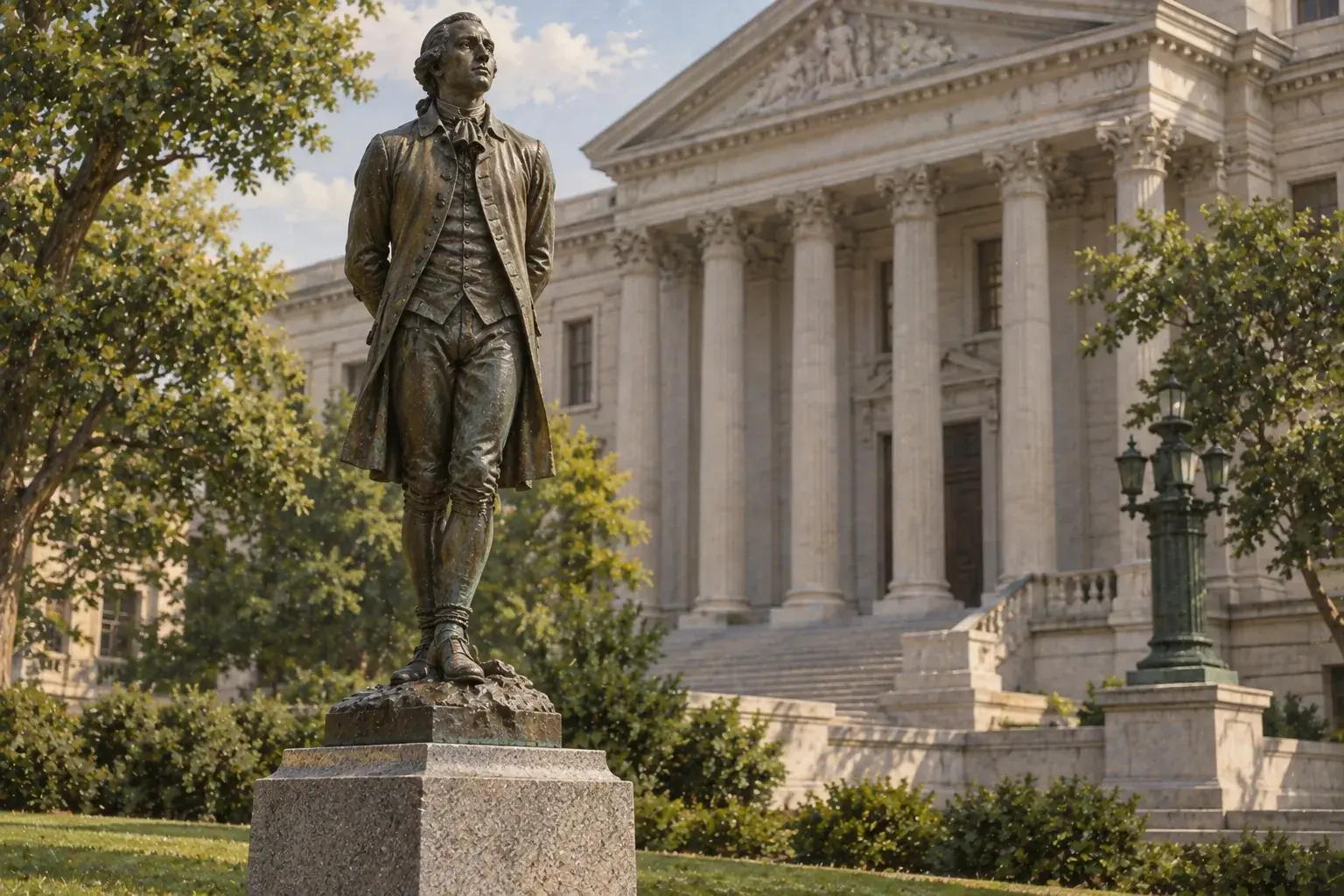
Replicas of the Yale statue, showing Hale with hands bound moments before his hanging, now stand at both the Department of Justice and CIA headquarters.
Benjamin Tallmadge And the Spy Ring Hale Inspired
There is, however, one final chapter to Hale's story that makes his death seem less like a waste.
Remember Benjamin Tallmadge, the classmate whose letter convinced Hale to enlist. After Hale's death, Tallmadge remained in the army, and eventually became Washington's chief of intelligence.
In 1778, he organized something called the Culper Ring, a network of spies operating out of New York, who passed on information to Washington until the end of the war. Unlike Hale's mission, the Culper Ring was well organized, and operated with a careful secrecy. Members used code names, invisible ink, numbered ciphers, and dead drops, to pass on their information. Some of the identities of the ring members were not revealed until more than a century later.
Many historians think, that Hale's failure was an important lesson, that led to the development of American intelligence methods. Send one untrained man, with his name written on his person, and you will lose him in ten days. But, create a network of well trained spys, and you can pass on information for the entire length of the war.
Hale is remembered as a hero, not because he was a good spy, (he was not), but because a 21-year-old teacher volunteered for a mission that no one else wanted to take, and had the grace to accept the consequences of his actions.