Oedipus works out what he's done, blinds himself and leaves Thebes with his daughter leading him. Most people stop there, because that's where the famous play ends. But the story doesn't stop, and what follows is arguably worse — a war between two brothers over a throne neither of them will live to sit on, and then a girl deciding that she will bury her brother's body even though it means being walled up alive. This is the rest of the house of Oedipus, and Greek drama returned to it more often than almost anything else.
Four Children, One Curse
Oedipus and Jocasta had four children before either of them knew what they were: two sons, Eteocles and Polynices, and two daughters, Antigone and Ismene. When the truth came out and Oedipus went into exile, the sons stayed in Thebes and the throne went — depending on the version — to their uncle Creon as regent. And in most tellings, Oedipus cursed his sons before he left. The reasons vary. In one version they served him a dishonourable cut of meat; in another they sent him away rather than caring for him; in the Thebaid, an early lost epic, it's a silver table and a wine cup that set him off. The specific slight is almost always trivial, which reads less like sloppy storytelling than like a point about how grievance works in a broken family. The curse itself is not trivial: that they should divide their inheritance with the sword.
The Arrangement
The brothers made a deal, and on paper it was sensible. They would rule in alternate years — one on the throne, the other away from the city, swapping annually. Eteocles went first. At the end of the year, he refused to hand over and expelled his brother instead. That's it. That's the whole cause of the war, and it's worth noticing how ordinary it is. No monster, no oracle, no divine intervention. Two men made an agreement and one of them broke it, and everything else follows. Polynices went to Argos, married the daughter of King Adrastus, and came back with an army.
The Seven
Seven champions were assembled, one for each of the seven gates of Thebes. The lists vary slightly, but the core is: Adrastus of Argos, the only one who survives; Polynices, the claimant; Tydeus of Calydon, small, ferocious, and the father of Diomedes; Capaneus, enormous and openly contemptuous of the gods; Hippomedon; Parthenopaeus, a son of Atalanta in some versions; and Amphiaraus, the seer. Amphiaraus is the one to watch, and his story is the most painful thing in the whole cycle. He was a prophet, and he knew before setting out that the expedition would fail and that every one of the seven except Adrastus would die, including himself. He refused to go. But he had once sworn an oath that in any dispute with Adrastus, he would abide by his wife Eriphyle's judgement. And Polynices had brought something with him from Thebes: the necklace of Harmonia, a divine heirloom that made its wearer irresistibly beautiful and destroyed everyone who owned it. He gave it to Eriphyle. She sent her husband to a death she knew he was expecting. Amphiaraus went, because he had sworn. Before leaving, he instructed his son Alcmaeon to avenge him — which meant instructing his son to kill his own mother, and Alcmaeon eventually did, and was hounded by the Furies for it exactly as Orestes was.
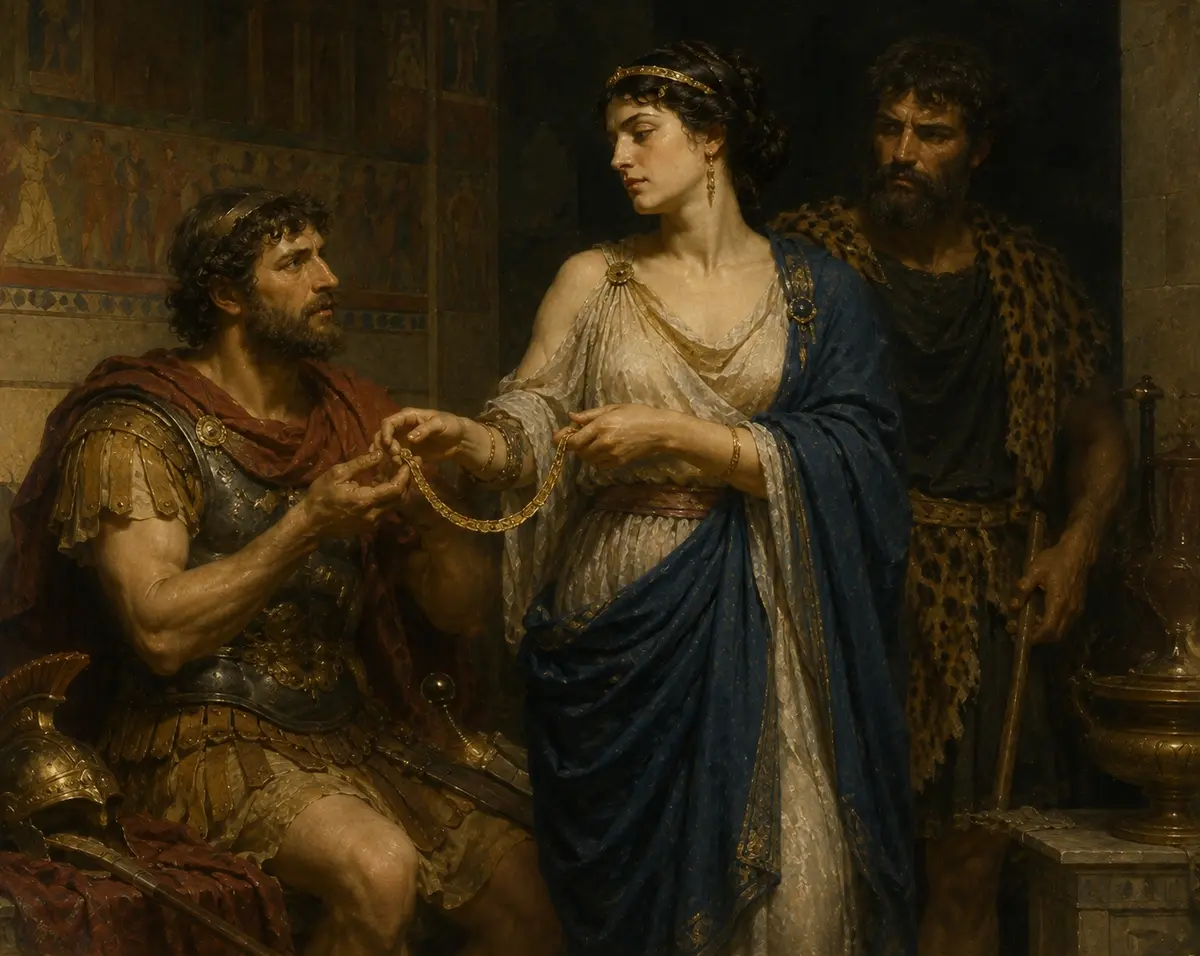
He knew the expedition would fail and that he would die in it. He went anyway, because he had sworn to abide by his wife's judgement — and she had just been bought.
The Assault
The seven attacked the seven gates. Aeschylus's Seven Against Thebes (467 BCE) stages this in a way that is unlike any other Greek tragedy. There's almost no action — instead, a messenger describes each attacking champion in turn, his shield device and his boast, and Eteocles responds by naming the Theban defender he will send against him and explaining why that man will beat that man. Seven times. It builds like a countdown, and the audience knows what's waiting at the seventh gate. The attackers were destroyed. Capaneus got a ladder onto the wall and shouted that not even Zeus could stop him now, and was hit by a thunderbolt in mid-climb — the most literal punishment for blasphemy in Greek myth. Amphiaraus, fleeing in his chariot, was swallowed by the earth when Zeus split the ground open, and afterwards received an oracle-shrine on the spot, which was a real and important sanctuary at Oropos that people visited for centuries. Tydeus was mortally wounded, and Athena — who was fond of him — came with a medicine that would have made him immortal. She arrived to find him splitting open the skull of the man who had wounded him and eating the brain. She turned round and left, and let him die. And at the seventh gate, Eteocles and Polynices met. They killed each other. Both of them, in the same fight. The curse was fulfilled precisely: they divided their inheritance with the sword, and each got as much Theban earth as a body takes up. Thebes held. Only Adrastus escaped, on a horse that had been sired by a god.
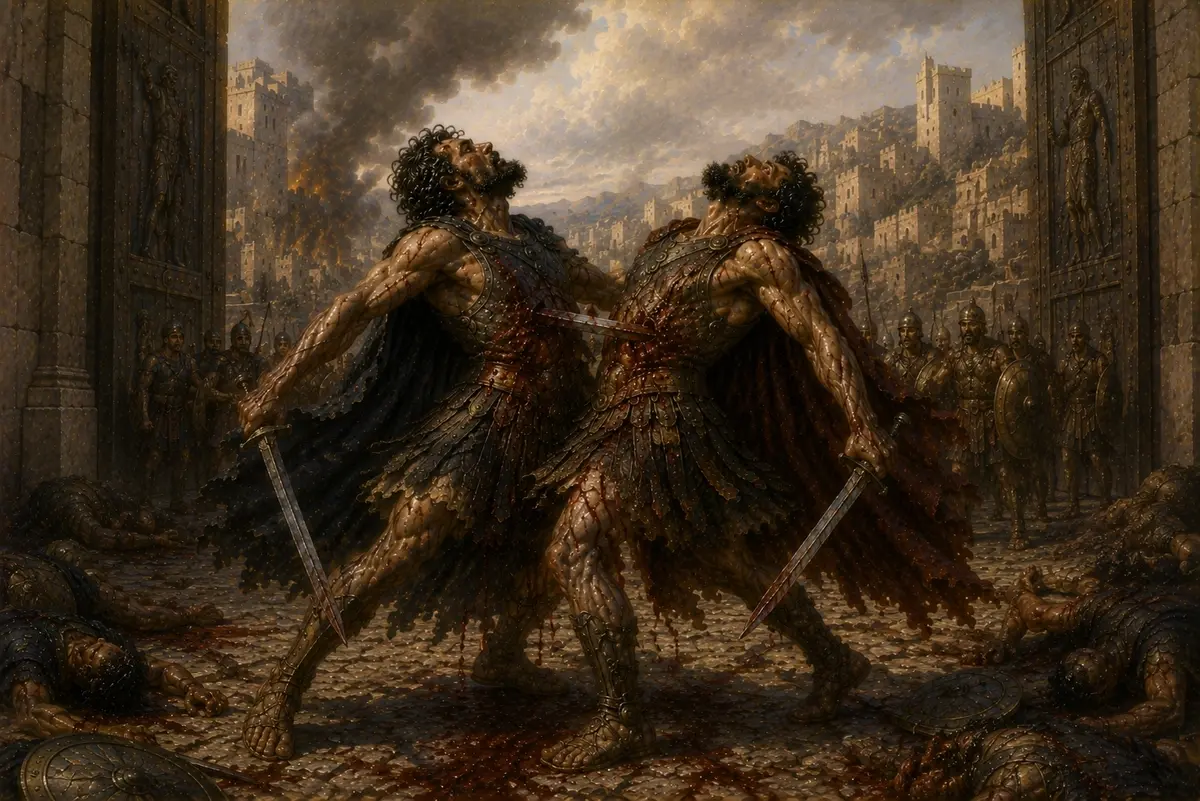
The curse was fulfilled precisely: they divided their inheritance with the sword, and each got as much Theban earth as a body takes up.
Antigone
Creon took the throne and issued an order. Eteocles, who had died defending the city, would be buried with full honours. Polynices, who had brought a foreign army against his own people, would be left where he fell — unburied, for the dogs and the birds — and anyone who tried to bury him would be executed. To an Athenian audience this was not an arbitrary cruelty. Denial of burial to traitors was a real Greek practice. Creon has a case. But leaving a body unburied was also a religious offence, and the obligation to bury a family member was one of the unwritten laws — the ones nobody legislates because everybody is assumed to know them. So the play is not a conflict between right and wrong. It's a conflict between two things that are both right, which is what makes it the most argued-over play ever written.
Antigone went out and buried her brother. Twice — the first covering was swept away by the guards, and she came back and did it again, and was caught. Her sister Ismene refused to help and then tried to share the punishment afterwards, and Antigone wouldn't let her, which is either loyalty or contempt depending on how you read it. Brought before Creon, Antigone doesn't deny it and doesn't apologise. Her argument is that Creon's edict is a man's proclamation, and that it cannot override the unwritten and unfailing laws of the gods, which are not of today or yesterday and which no one knows when they first appeared. Creon's argument is that a state cannot survive if every citizen decides for themselves which laws to obey, and that the man who brought an army against his own city cannot be honoured equally with the man who died stopping him. Neither of them gives way. Sophocles makes both of them rigid, and the tragedy is in the rigidity rather than in either position.
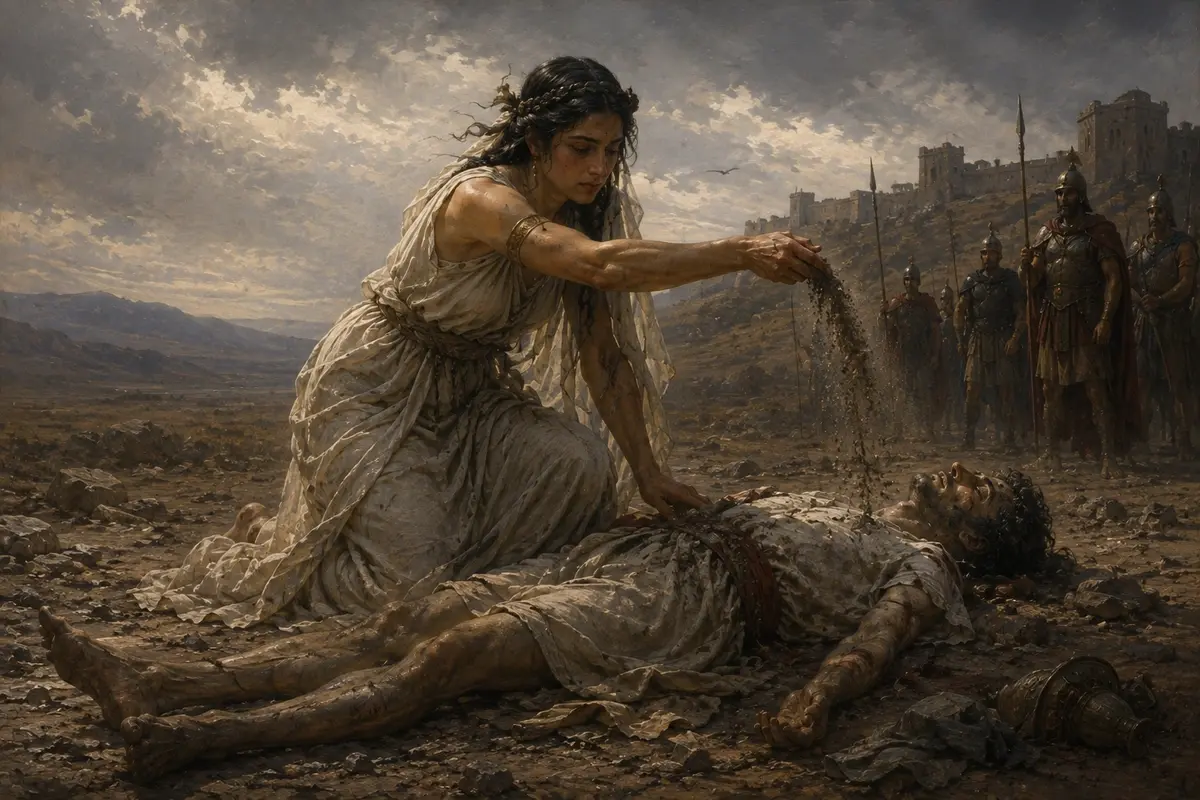
She did it twice. The guards swept the first covering away and she came back and did it again. Her argument was that a man's proclamation cannot override the unwritten laws.
The Collapse
Creon has her walled up alive in a cave — a technicality, so the city isn't polluted by directly executing a relative. His son Haemon, engaged to Antigone, pleads with him and gets nowhere, and the argument between father and son is one of the best-written scenes in Greek drama: Haemon telling him that the whole city thinks he's wrong and is too afraid to say so, and Creon hearing only insubordination. The blind prophet Tiresias — who is the recurring signal in this family that something has gone badly wrong — tells Creon that the gods are rejecting Theban sacrifices because the altars are fouled with carrion from the unburied body, and that he will pay with one of his own children. Creon finally breaks, and goes to fix it. He buries Polynices first, then goes to the cave. Antigone has already hanged herself. Haemon is there with her body. He attacks his father, misses, and kills himself on the spot. Creon's wife Eurydice, hearing the news, kills herself too, cursing him. He is left alive with nothing, which is the standard Greek punishment for this kind of error and the reason Antigone is the play's title character but Creon may be its tragic figure.
The Epigoni
Ten years later the sons of the seven — the Epigoni, meaning the ones born after — went back to Thebes to finish it. This time they took the city and destroyed it. Alcmaeon, son of Amphiaraus, led them. And when he came home he killed his mother Eriphyle, as his father had told him to, because she had been bribed again — this time with the robe of Harmonia, to send her son the way she'd sent her husband. The Furies took him. He wandered like Orestes, went mad, and was eventually murdered. The house of Oedipus generates atrocity for four generations, which is more or less the point. Once the first thing goes wrong, nothing in this family can be resolved without producing the next thing.
Why It Keeps Getting Rewritten
Antigone has been reworked more than any other Greek play, and always at moments when the question is live. Jean Anouilh staged a version in Paris in 1944, under German occupation, which passed the censors because Creon's arguments were given real force — and which the Resistance read as a manifesto. Both readings were available in the same theatre on the same night, which is exactly the play's design. Bertolt Brecht adapted it in 1948 with Creon as a warlord. Athol Fugard's The Island (1973) had two political prisoners on Robben Island rehearsing it. Seamus Heaney's The Burial at Thebes (2004) was written with the Iraq war in mind. Kamila Shamsie's novel Home Fire (2017) transposes it to a British Muslim family and a brother who joins ISIS, and won the Women's Prize for Fiction. The reason is that the question never resolves. What do you owe the state, and what do you owe your dead? Sophocles refused to answer it in 441 BCE and nobody has managed since.