Ten thousand Greek soldiers are 1,500 kilometres inside the Persian Empire. The man who hired them is dead. Their generals have been invited to a negotiation and murdered. They have no maps, no supplies, no guides, no allies, no way home, and a hostile empire on every side. What they do next is one of the great survival stories in history, and it was written down by a man who was there — a thirty-something Athenian cavalry officer with no command experience who got elected general in the middle of the crisis and had to work out how to do the job while doing it. Xenophon's Anabasis is the best-attested military account to survive from the ancient world, and it is a genuinely gripping read 2,400 years later.
Why They Were There
The Peloponnesian War ended in 404 BCE. It left behind a Greek world full of professional soldiers with two decades of experience and nothing to do, and a labour market for them across the Aegean. In Persia, Darius II died in the same year. His elder son took the throne as Artaxerxes II. His younger son, Cyrus the Younger, satrap of Asia Minor, thought the throne should have been his. Cyrus had personally bankrolled the Spartan fleet that finished Athens off, which meant he had a great deal of credit with Sparta and knew exactly how good Greek heavy infantry was. So he hired around 13,000 Greek mercenaries and told them almost nothing. The stated mission was a punitive campaign against a hill tribe. They marched east. And kept marching east. Somewhere around the Euphrates, well past any plausible destination, they worked out that they were going to Babylon to fight the King of Kings, and stopped and refused to move. Cyrus handled it with money — he raised their pay by half. They went on. The Greek word anabasis means the march up — inland from the coast. That's the title, and it covers only the first fifth of the book.
Cunaxa, 401 BCE
They met the royal army at Cunaxa, near Babylon. Realistically Artaxerxes had a large force and Cyrus had perhaps 30,000 including the Greeks. The Greeks were on the right wing, and they did exactly what Greek hoplites did. They advanced, raised the paean, and the Persian troops facing them broke and ran before contact. The Greeks pursued and won their part of the field without losing a man. It didn't matter, because Cyrus lost his. He spotted his brother in the centre, charged him personally with his household cavalry, wounded him — and was killed in the scrimmage around him. And with that, the entire enterprise evaporated. The Greeks came back from a successful pursuit to find they had won their battle and lost their employer, their cause and their pay. Xenophon's line on the situation is dry and devastating: they were victorious, and there was nobody left to be victorious for.
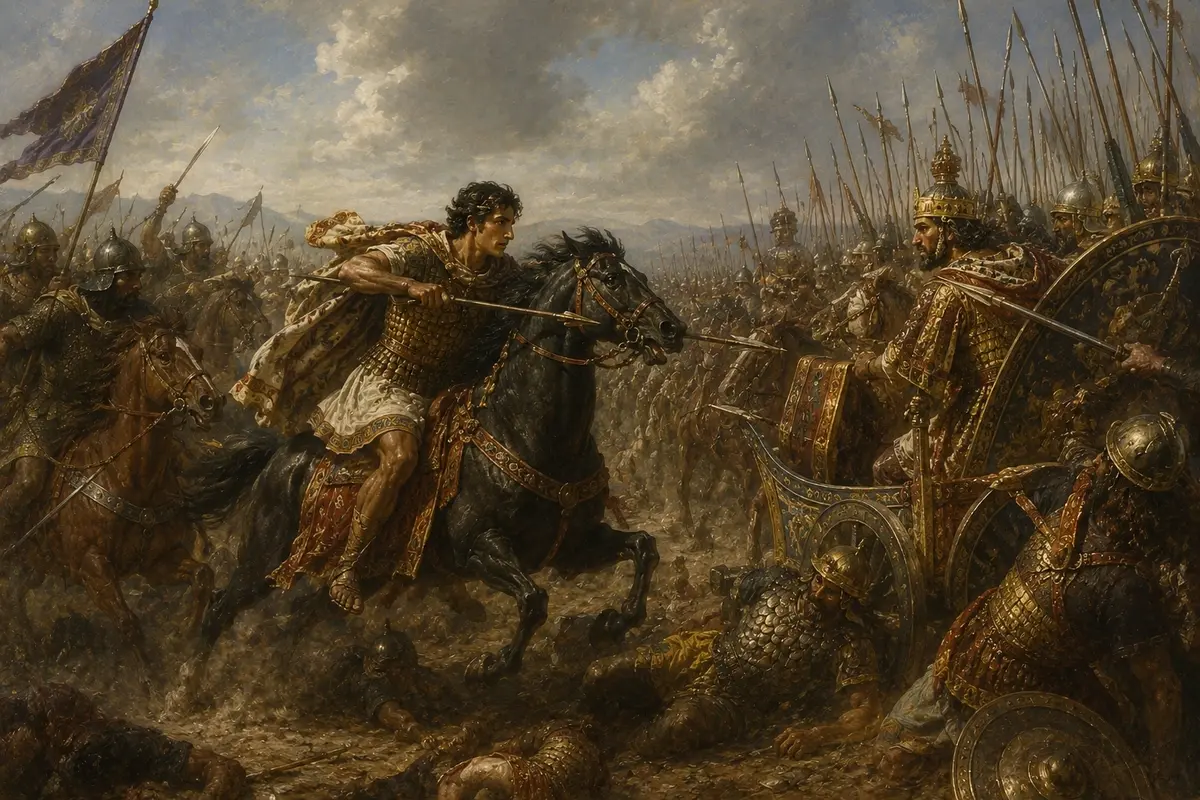
The Greeks won their part of the battle without losing a man. Then Cyrus was killed charging his brother personally. They were victorious, and there was nobody left to be victorious for.
The Murder of the Generals
The Persians, quite reasonably, wanted these men gone. What followed was a fortnight of negotiation with the satrap Tissaphernes, who offered guides, a truce and safe passage north. Then he invited the Greek commanders to his tent to settle the final arrangements. The senior Spartan general, Clearchus, took four other generals and about twenty captains. They were seized at the door. The captains were killed on the spot; the generals were sent to Artaxerxes and beheaded. It was efficient and it should have worked. Decapitate the command structure of a mercenary army in hostile territory and it dissolves into a mob you can hunt down at leisure.
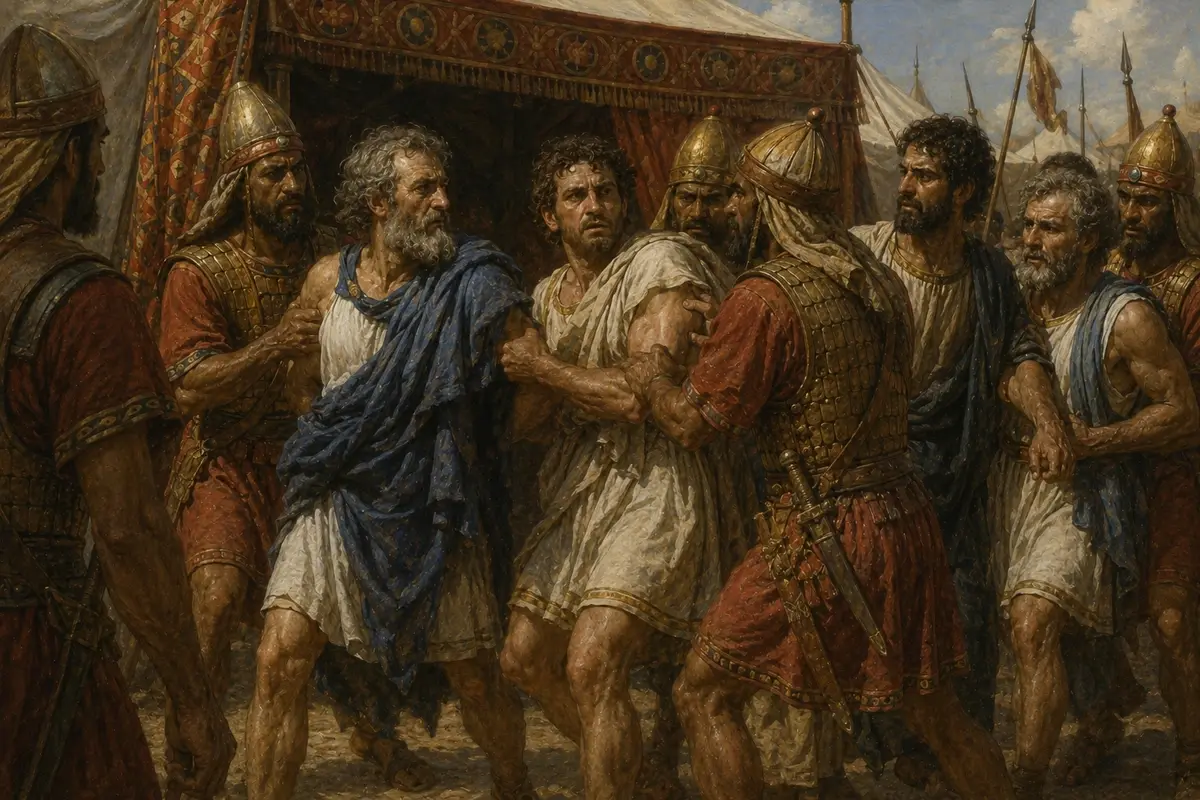
Decapitate the command structure of a mercenary army in hostile territory and it dissolves into a mob you can hunt down at leisure. That was the plan. It didn't work.
The Night Everything Changed
That night, in the camp, almost nobody slept. And Xenophon — who held no rank at all, who wasn't a mercenary, who had come along as a private guest on the advice of Socrates and the oracle at Delphi — got up in the dark and started waking the surviving officers of his contingent. His argument was simple to the point of bluntness: waiting for morning is waiting to die. The Persians clearly think the army is finished, and the only thing that will change that is if it isn't. Elect new commanders now, before dawn, and march at first light. They elected new generals from among the surviving captains. Xenophon was made one of them. He was around thirty, an Athenian in an army that was overwhelmingly Spartan and Arcadian, and had never commanded anything. The army that formed up at dawn was under new management and moving.
The March North
They could not go back the way they came — the country had been stripped bare on the way in. So they went north, up the Tigris, into mountains nobody in the army had ever seen, aiming for the Black Sea and Greek colonies on its shore. Persian cavalry and archers harassed the column constantly. The Greeks improvised: they formed a unit of Rhodian slingers who could outrange Persian archers because Rhodians used lead shot, and scraped together a small cavalry force. The Carduchi — mountain tribes in what is now Kurdistan — cost them more casualties in seven days than the Persian Empire had managed in months. Xenophon notes bleakly that these people had beaten a Persian army of 120,000 and none of them had come home. The Greeks fought through the passes by sending detachments to seize high ground above the tribesmen, which meant climbing all night to attack downhill at dawn. Armenia in winter was worse. Deep snow, no shelter, temperatures that caused frostbite and snow blindness. Men lay down in the snow and refused to get up, and Xenophon describes going along the column physically hauling them upright. They learned to grease their feet, to keep something over their eyes, to sleep on their packs. Through it all, they held the assembly. This is the thing about the Anabasis that people find hardest to believe. The Ten Thousand made decisions by vote. They debated routes in the field. They prosecuted their own officers. It was a Greek city-state that happened to be walking.
Thalatta
In the spring they came up to a mountain called Theches, and the vanguard reached the summit and started shouting. Xenophon was with the rearguard and thought the front of the column was under attack. He got horses and rode forward, and as he got closer he could make out what they were yelling: Thalatta! Thalatta! — the sea! The sea! It was the Black Sea, and it meant Greek colonies, ships, and home. Xenophon describes what happened next without any embellishment at all: men ran up and kept shouting and passed it back down the line, and everyone came up including the baggage handlers and the animals, and then they were embracing each other and crying — officers, ordinary soldiers, everyone. Then they built a cairn of stones on the summit, and piled on it whatever they had — captured shields, ox-hides, sticks. The guide who had brought them there was given a horse, a silver cup, a Persian robe and ten darics, and asked mostly for rings, and went back down the mountain. It is, I think, the best-written moment in ancient historiography. Two Greek words that have been quoted for two and a half thousand years — by Heine, by Joyce in the opening pages of Ulysses, by anyone who has ever come over a ridge and seen the end of something.
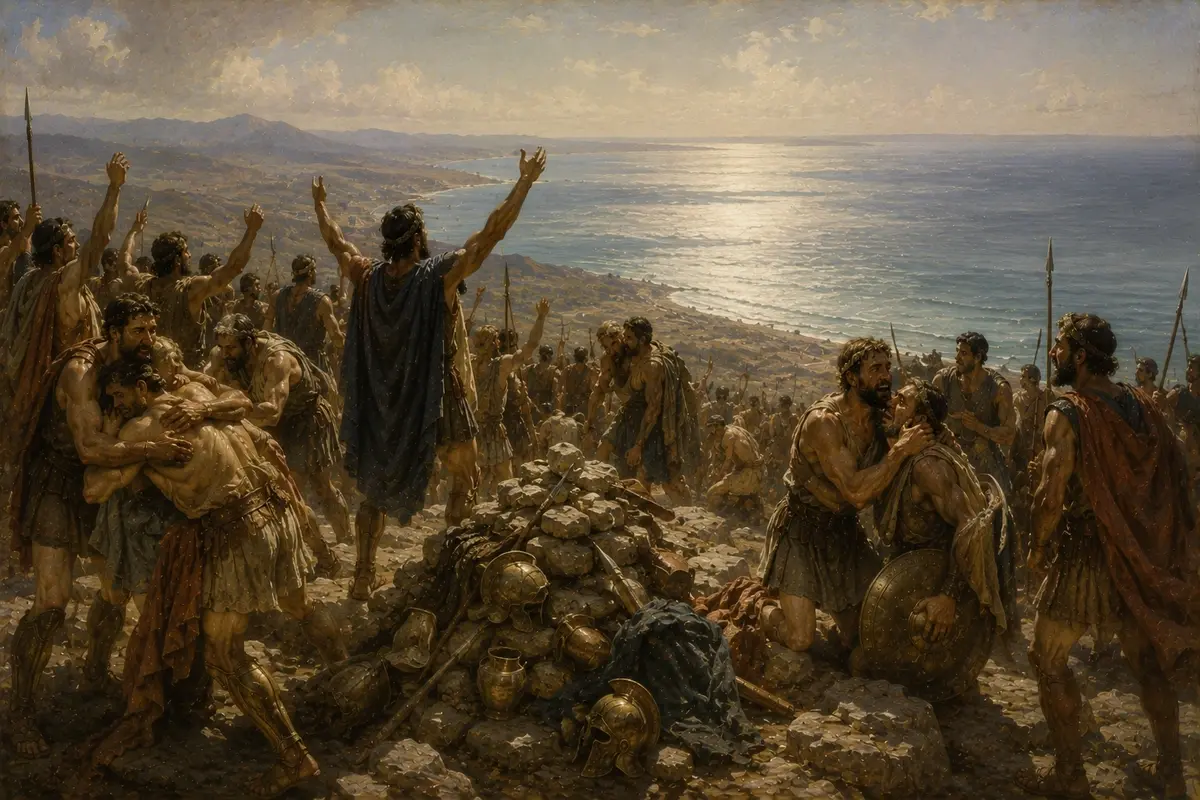
Thalatta! Thalatta! The sea, the sea! They built a cairn on the summit and piled on it whatever they had. Then they went back down.
Getting Home Was Not the End
The march took roughly fifteen months and covered something like 4,000 km. Of the original force, perhaps 6,000 made it. And reaching the sea didn't solve anything. The Greek colonies on the Black Sea coast were alarmed rather than delighted by the arrival of six thousand armed, unpaid, hungry professionals. The last quarter of the Anabasis is a grubby, fascinating account of the army trying to find someone to hire it, occasionally plundering, arguing about money, and gradually falling apart. Xenophon himself was exiled from Athens — for serving with Cyrus, or for fighting alongside Sparta, or both — and spent much of his life on an estate in the Peloponnese given to him by the Spartans, writing.
Why It Mattered So Much
It exposed the empire. A Greek army had marched to Babylon, won its part of a battle against the King of Kings, lost its leadership, and then walked home through the middle of Persian territory. Nobody stopped it. The strategic lesson was obvious and it was drawn immediately. Agesilaus of Sparta invaded Asia Minor within a few years. Alexander carried it through — he had read the Anabasis, followed part of the same route in reverse, and took Xenophon's account seriously enough that ancient writers thought it had shaped his thinking. The Ten Thousand demonstrated that the Persian Empire was militarily hollow at the centre seventy years before Alexander crossed the Hellespont. It's also the first great memoir. Xenophon writes about himself in the third person — which lets him record his own speeches while keeping the tone of a report. He is unusually honest about the practicalities: what men ate, what they argued about, how cold it was, how they voted, what it cost to hire a guide. And it keeps getting retold. Sol Yurick's 1965 novel The Warriors transposed it to New York street gangs, and the 1979 film is the Anabasis with a different soundtrack. The leader is called Cyrus. The film does not pretend otherwise.