Herodotus tells this story in Book 3, and it's the clearest statement he ever made of an idea that runs through his entire history: that the gods resent people who never lose. It's also, unusually for a Greek moral tale, a story about someone who tries to do the right thing — who takes the warning seriously, acts on it deliberately, at real cost — and finds out that this doesn't help either.
The Luckiest Man in the Aegean
Polycrates seized power on the island of Samos around 538 BCE, in the standard fashion of the age: a coup, initially shared with two brothers, one of whom he killed and one he exiled shortly afterwards. And then everything he touched worked. He built a fleet of a hundred ships and took control of the eastern Aegean, raiding wherever he liked. Herodotus says he plundered without distinction, and defended it with a line that's almost charming — that he would earn more gratitude from a friend by giving back what he had taken than by never taking it at all. He made an alliance with Amasis, the pharaoh of Egypt. He filled Samos with poets — Anacreon lived at his court — and with engineering projects that were the wonder of the Greek world.
Those projects were real and two of them still exist. The temple of Hera was the largest Greek temple yet attempted. The mole in the harbour ran out into deep water. And the Tunnel of Eupalinos — a water conduit driven straight through a mountain for over a kilometre — was dug from both ends simultaneously, and the two teams met in the middle. It was done in the 6th century BCE without magnetic compasses, and you can walk through it today. Herodotus calls the three of them the greatest works in the Greek world, and he wasn't overstating. He also, when the Persians and the Spartans came at him from different directions, won or survived every time. A Spartan expedition besieged Samos for forty days and gave up and went home. Nothing went wrong. For years.
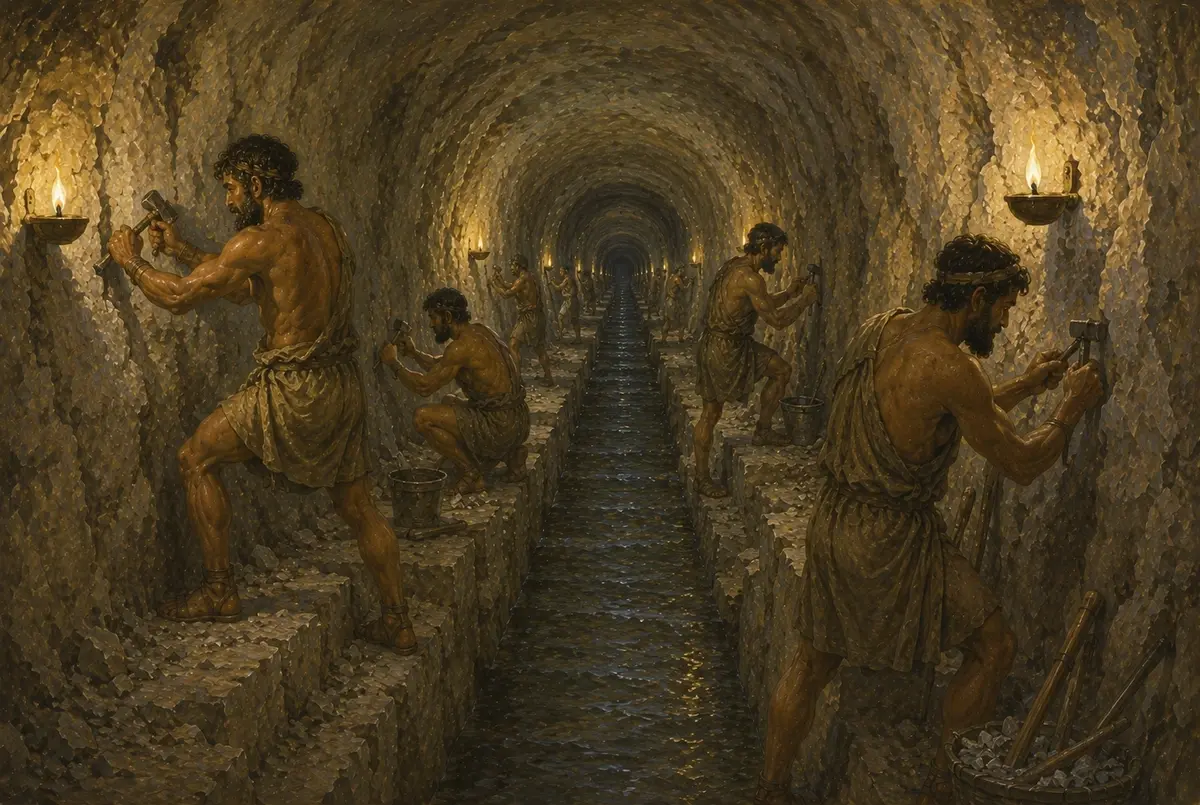
Over a kilometre, dug from both ends simultaneously in the 6th century BCE without magnetic compasses — and the two teams met in the middle. You can walk through it today.
The Letter
Amasis, watching from Egypt, became uneasy. He wrote to Polycrates, and Herodotus gives us the letter. It's an odd document — an ally writing to say that his friend's success has become alarming. The argument runs like this. It is pleasant to hear that a friend is doing well. But your enormous good fortune does not please me, because I know how jealous the divine is. What I would want for myself and for those I care about is to succeed in some things and fail in others, and to go through life alternating rather than prospering in everything. I have never heard of anyone who succeeded at everything who did not come to a completely bad end. So take my advice: find whatever you value most, the thing whose loss would hurt you most, and get rid of it in such a way that it can never come back. And if after that your luck still isn't broken by any setback, keep applying the remedy.
The Ring
Polycrates read it and agreed. This is the part I find genuinely interesting — he doesn't dismiss it. He works out that Amasis is right and sets about doing something about it. He went through his possessions looking for the one whose loss would hurt most, and settled on a signet ring: an emerald set in gold, made by Theodorus of Samos, a jeweller famous enough that Herodotus names him. Then he did it properly. He manned a fifty-oared ship, went out into deep water, and in front of the whole crew took the ring off and threw it into the sea. Then he went home and, Herodotus says, grieved. Which is the point — the sacrifice only counts if it costs you.
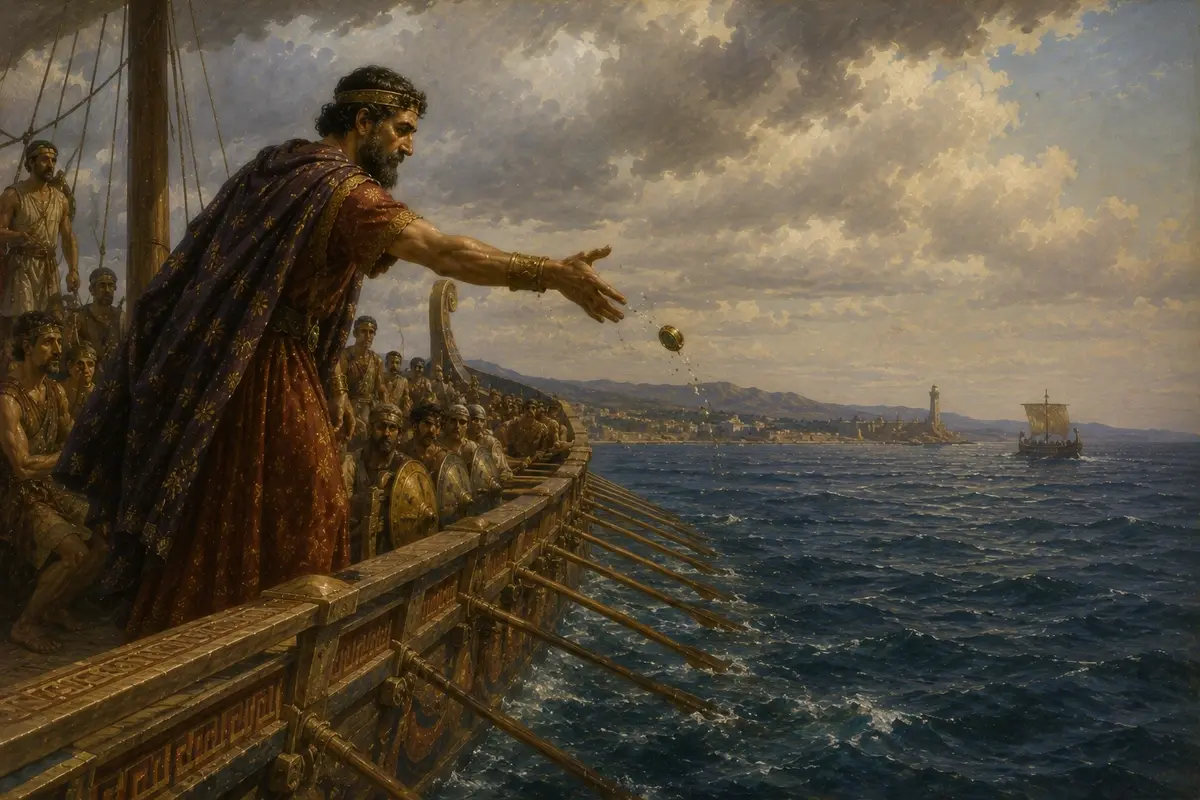
He did it properly — in deep water, in front of the whole crew. Then he went home and grieved. The sacrifice only counts if it costs you.
The Fish
Five or six days later, a fisherman caught a fish so large and fine that he decided it wasn't right to sell it at market. He brought it to the palace as a gift for the tyrant. Polycrates was pleased, invited him to dinner, and the fish went to the kitchen. The cooks cut it open and found the ring. They brought it to Polycrates, who was delighted — and then, because he was not a stupid man, wrote to Amasis explaining exactly what he had done and exactly what had happened. And Amasis read the letter and understood immediately that it was over. Herodotus says he saw that it was impossible for one man to rescue another from what was coming, and that Polycrates, who succeeded at everything and even got back what he threw away, was going to end badly. So he sent a herald to Samos and formally dissolved the friendship — and Herodotus is explicit about the reason. He broke off the alliance in advance so that when the catastrophe came he would not have to grieve for a friend. That is a very cold piece of self-protection, and it's completely in character for the world Herodotus is describing.
What Happened
Oroetes, the Persian satrap at Sardis, decided to destroy Polycrates. Herodotus offers two explanations for the motive, admits he doesn't know which is right, and picks the pettier one: that Oroetes had been mocked by a colleague for never having taken Samos. The trap was well designed. Oroetes sent word that he was in danger from the Persian king and wanted to escape with his fortune, and that Polycrates could have half of it if he provided refuge. He invited him to come and inspect the treasure. Polycrates was tempted. Samos had ambitions and money was the constraint. He sent a man to check first, and Oroetes filled eight chests with stones, put a layer of gold on top of each, and had them shown to the inspector, who reported back that it was real. His daughter had a dream warning her that her father would be washed by Zeus and anointed by the sun. She begged him not to go. He told her that if he came back safely he would keep her unmarried for a long time — which she took, correctly, as a threat. He went to the mainland in 522 BCE, and Oroetes seized him and crucified him. Herodotus records the dream coming true in the ugliest possible way: the body on the cross was washed by the rain and its moisture drawn out by the sun. He adds only that Polycrates died in a manner unworthy of himself and his ambitions.
What the Story Is For
Herodotus is building a case across his whole history, and Polycrates is one of its clearest exhibits. The divine is jealous — phthonos theon. Solon says it to Croesus in Book 1. Amasis says it to Polycrates in Book 3. Artabanus says it to Xerxes in Book 7 — that the god strikes the tallest buildings and the tallest trees, and cuts down whatever rises above the rest. It's not morality. Polycrates isn't punished for being cruel, though he was. He is punished for being conspicuous. And you cannot buy your way out. This is what makes the story better than the Croesus one. Croesus ignores the warning. Polycrates takes it, acts on it decisively, at genuine cost, in public — and the sea gives the ring back. The universe declines the offering. There's something almost frightening in that. The story isn't saying be humble and you'll be fine. It's saying that once you're on this trajectory, humility is a gesture you can perform and it will not be accepted. Amasis understands this instantly, which is why he cuts the man off rather than warning him again.
Afterwards
The story had a long life. Friedrich Schiller turned it into a ballad, Der Ring des Polykrates, in 1797, and it became one of the standard poems learned by heart in German schools — which is why the phrase still has currency in German in a way it doesn't quite in English. The engineering outlasted the moral. Samos never recovered its position after Polycrates, but the Tunnel of Eupalinos is a UNESCO World Heritage Site, and it is the reason engineers still know his name. A tyrant who was destroyed for excessive good fortune is remembered because he commissioned a very good piece of surveying.