Everyone knows the caricature: the arrogant god-king who ordered the sea flogged for wrecking his bridge, marched millions of men into Greece, and lost to a few thousand free Greeks who wanted it more. That version comes to us almost entirely from the people who beat him, and there is another Xerxes in the record — one who ruled the largest empire the world had yet seen for twenty-one years, completed the great building programme at Persepolis, and whose Greek campaign was a two-year episode in a long reign that Persian sources barely bothered to mention. Both versions are worth having, and the gap between them is instructive.
The Empire He Inherited
Xerxes came to the throne in 486 BCE as the fourth king of the Achaemenid Empire, which at that point ran from the Indus to Libya and from the Aral Sea to the Persian Gulf. Something like forty per cent of the world's population lived in it. It was not a crude conquest state. It ran on a system of satrapies — provinces with considerable local autonomy, standard taxation, a road network with staging posts, an imperial postal service, a common administrative language in Aramaic, and a general policy of leaving local religion and custom alone. That last part is why the Hebrew Bible treats Persian kings so much more warmly than Greek writers do. Xerxes was the son of Darius I and Atossa, a daughter of Cyrus the Great — which made him the first king to combine both royal lines, and was the argument for his succession over an elder half-brother. He spent his first years doing what a new Persian king did: putting down revolts in Egypt and Babylon. The Babylonian rising was serious, and his response was hard, though how far he went is disputed and later Greek accounts exaggerate. Then he turned to the unfinished business.
Why Greece
His father Darius had sent a punitive expedition against Athens and Eretria in 490 BCE, and it had been beaten at Marathon. That could not stand. It wasn't about territory — Greece was poor and marginal by Persian standards. It was that a subject people had revolted, been supported by two Greek cities, and those cities had then defeated an imperial army and gone unpunished. In an empire held together by the belief that revolt is futile, that is a serious problem. Herodotus also records that Athens and Sparta had killed Darius's heralds. Athens tried and executed them; Sparta threw them into a well and told them to collect their earth and water from down there. Under any code of the period, and especially the Persian one, that was an atrocity. So Xerxes prepared, for four years, on a scale that was itself the message.
The Engineering
The preparations are the most impressive thing about the campaign and the part usually reduced to a punchline. The Athos canal. An earlier Persian fleet had been destroyed rounding the stormy headland of Mount Athos. Rather than risk it again, Xerxes had a canal cut through the peninsula — roughly two kilometres long, wide enough for two triremes to pass, dug over about three years by a conscripted workforce with supervisors and rationed supplies. Herodotus sneers at this as pure ostentation, arguing the ships could simply have been dragged across the isthmus. He was wrong to sneer, and — importantly — the canal is real. Geophysical surveys in the 1990s and 2000s located the buried channel running across the neck of the peninsula, confirming an account most historians had treated as exaggeration.
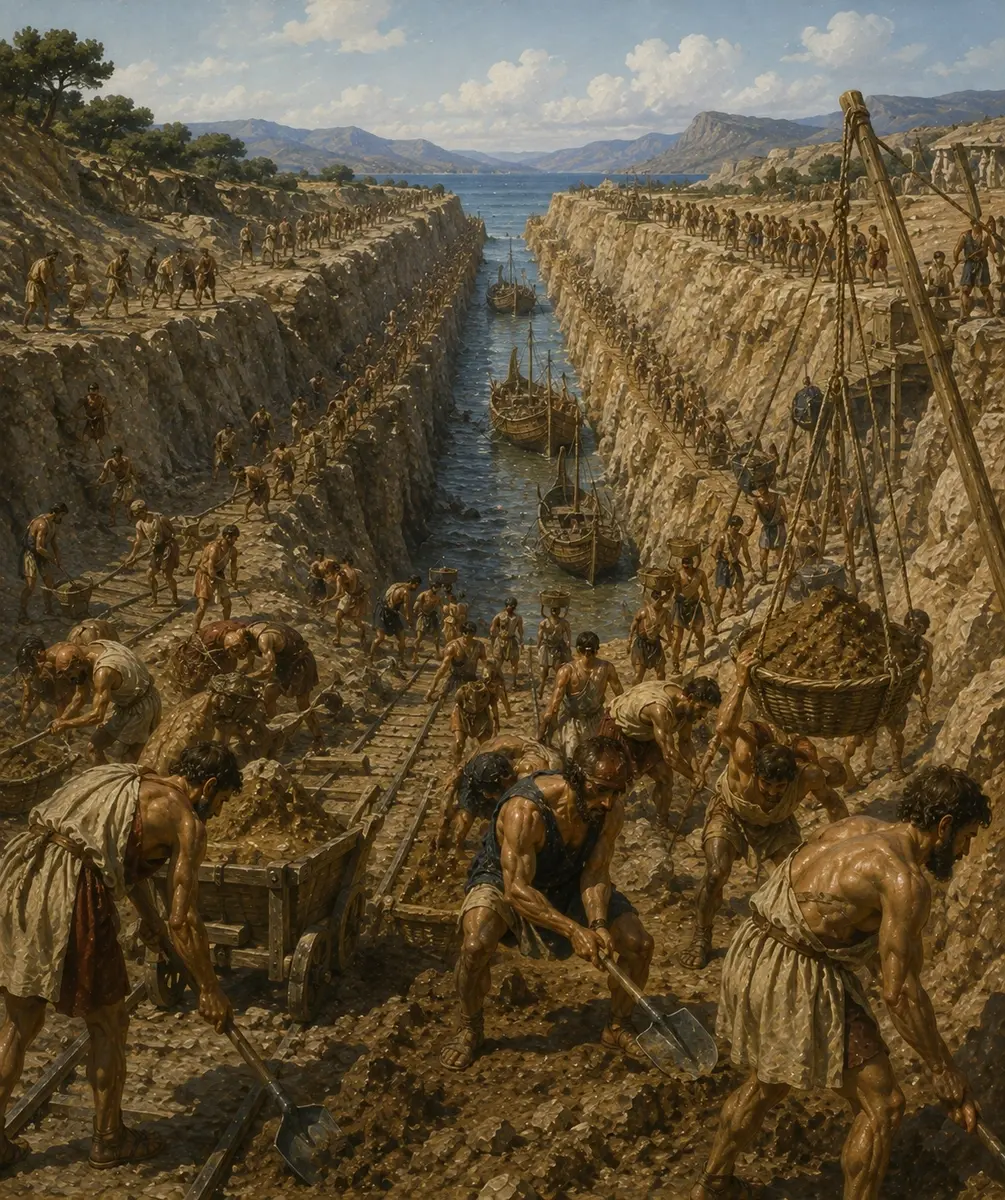
Herodotus dismissed it as ostentation. Geophysical surveys in the 1990s and 2000s located the buried channel — the canal was real, and it was dug in about three years.
The Hellespont bridges. Two pontoon bridges across the strait between Asia and Europe, made by mooring several hundred ships side-on to the current, running enormous cables of flax and papyrus over them, and laying a road of brushwood and earth on top with screens at the sides so the pack animals wouldn't see the water and panic. A storm destroyed the first attempt. And here is the famous episode: Xerxes had the engineers beheaded, and ordered the Hellespont itself given three hundred lashes, a pair of fetters thrown into it, and — in some versions — branded with hot irons, while a herald addressed the water as a bitter stream being punished by its master. That story is in Herodotus and it is almost certainly a Greek moralising invention, or a garbled account of a ritual. It's exactly the anecdote a culture obsessed with hubris would produce about a foreign king. But it stuck so completely that it's now the one thing most people know about him. The second attempt held. The army crossed for seven days and nights without stopping. The supply chain deserves a mention too. Depots were established along the route years in advance, and cities on the line of march were required to feed the army for a day and spent months preparing that single meal. This was a logistical operation of a sophistication that Greek states could not have attempted.
How Big Was the Army, Really?
Herodotus says 1,700,000 infantry, 80,000 cavalry, and a total force with support of 5,283,220. It isn't possible and hasn't been believed for over a century. The classic demolition is Sir Frederick Maurice's 1930 study, which worked out the water available along the actual route and concluded that around 150,000 soldiers was the absolute ceiling. Modern estimates cluster between 80,000 and 300,000, with the low end gaining support. Even at the low end it was the largest army assembled anywhere up to that point. It just wasn't a number that would have taken months to cross a bridge. Herodotus also gives Xerxes a moment that is the best-written thing in the Histories. Reviewing the whole army and fleet from a marble seat at Abydos, he first congratulated himself, and then wept — because in a hundred years not one of the men in front of him would be alive. His uncle Artabanus said that was the least of it: that in a life this short there is no one who will not wish more than once that he were dead. Whatever else Herodotus was doing, he was not writing a simple villain.
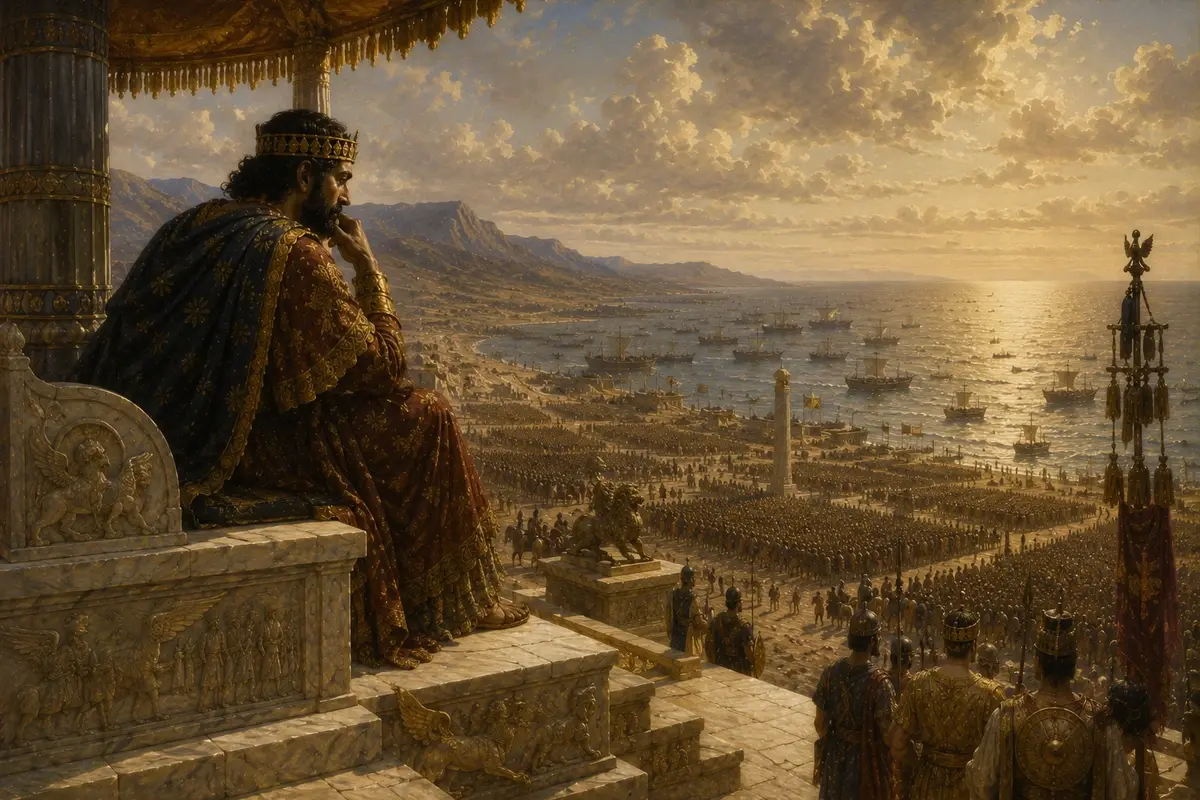
He congratulated himself, and then wept — because in a hundred years not one of the men in front of him would be alive. Whatever else Herodotus was doing, he was not writing a simple villain.
What Actually Happened
Thermopylae, in August 480 BCE — the pass held for three days by around 7,000 Greeks and then turned by a mountain path. Xerxes won, and had Leonidas's body decapitated and crucified, which Herodotus notes was unusual and out of character for Persians, who normally honoured brave enemies. Athens was taken and burned, temples and all. The stated objective of the entire campaign was achieved. Salamis, in September 480 BCE — the fleet destroyed in a narrow strait after Themistocles fed Xerxes a false report. Xerxes watched from a hillside throne with secretaries recording which of his captains did well. And here is where the popular version distorts things badly. Xerxes did not flee in panic. He withdrew with part of the army before winter — which was sensible, since the fleet's destruction meant he could no longer supply a force that size in Greece — and left his general Mardonius with a substantial army to finish the job. That army was destroyed at Plataea in 479 BCE, and the remaining fleet at Mycale, and then it was over. Xerxes reigned for another fifteen years and appears not to have thought about Greece much afterwards.
The Rest of His Reign
This is the part that vanishes from Greek-centred accounts. Xerxes completed the great building programme at Persepolis that his father had begun — the Apadana audience hall, the Hall of a Hundred Columns, and the monumental Gate of All Nations, which still stands and still carries his inscription. The reliefs on the Apadana staircase show delegations from every corner of the empire bringing gifts, carved with a care that is worth going to look at. He left inscriptions in Old Persian, Elamite and Babylonian, and one of them — the so-called "daiva inscription" — records the suppression of a cult he disapproved of and his promotion of Ahura Mazda. Scholars argue about what it actually refers to. In 465 BCE he was murdered in his bedchamber by Artabanus, the commander of the royal bodyguard, apparently with the involvement of a eunuch of the household. His eldest son was killed too, and his son Artaxerxes I took the throne and had the conspirators executed. Death by palace coup, twenty-one years into a reign, in the middle of an empire that carried on afterwards without much disturbance.
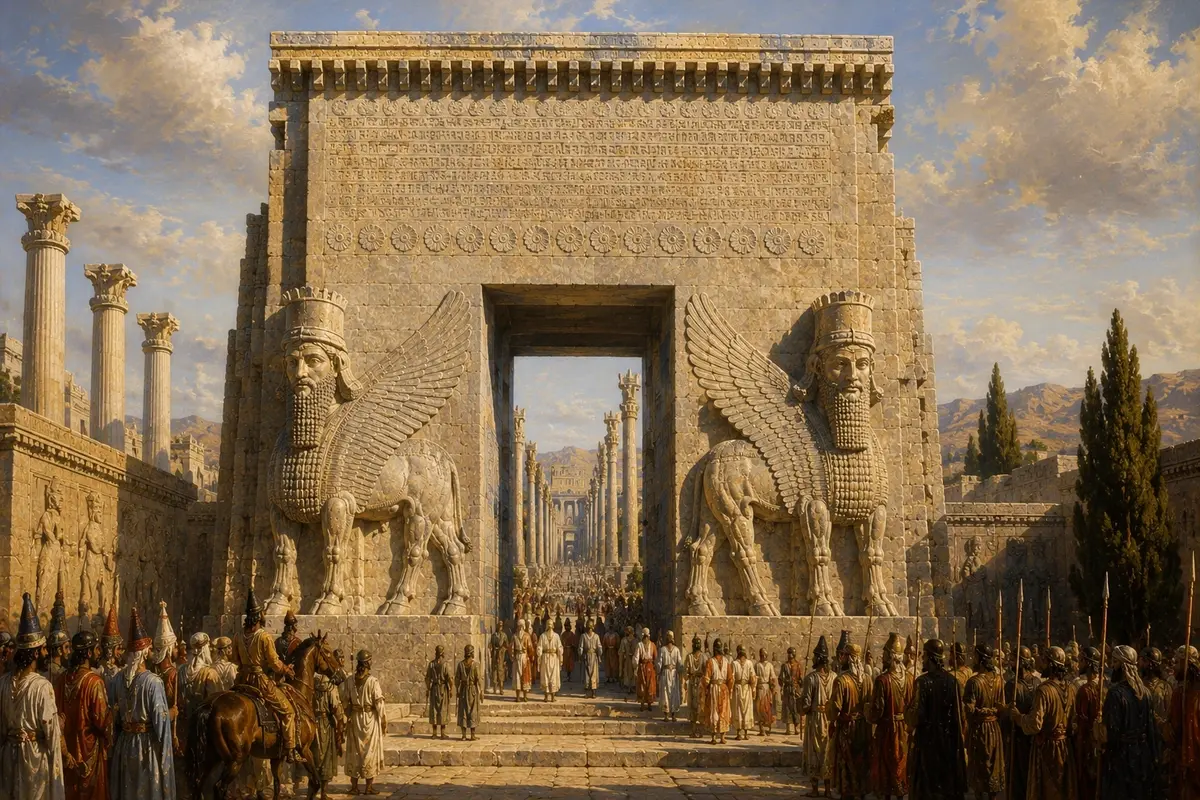
The part that vanishes from Greek-centred accounts. He completed the Apadana, the Hall of a Hundred Columns, and this — which still stands and still carries his inscription.
The Xerxes Problem
Almost everything narrative we know comes from Greek sources, and specifically from Herodotus, writing fifty years later in a culture that had defined itself by beating this man. Persian royal inscriptions are formal, religious and not narrative — they record titles, building works and devotion to Ahura Mazda. Administrative tablets from Persepolis tell us about rations and travel authorisations. Nothing from the Persian side describes the Greek campaign at all, which itself tells you how marginal it was to them. So the flogging of the sea, the tears at Abydos, the beheaded engineers, the throne on the hillside — these are Greek literary constructions in a work that is partly an inquiry into why great men fall. There's also a Xerxes in the Hebrew Bible. He is generally identified with Ahasuerus in the Book of Esther, ruling from India to Ethiopia — a rather different portrait, and one that reflects the Persian policy of religious tolerance that made Greek writers' account of Persian despotism look one-sided. And there is a third Xerxes: the one Aeschylus put on stage in 472 BCE, eight years after Salamis, in The Persians. Written by a man who had fought at Marathon and possibly Salamis, performed in Athens, and told entirely from the Persian point of view — the queen mother waiting for news, the messenger's account of the disaster, and Xerxes returning in torn clothes to a chorus lamenting for the dead of Asia. That an Athenian audience sat through a tragedy asking them to grieve for the enemy, less than a decade after the enemy burned their city, is one of the more remarkable facts in cultural history.