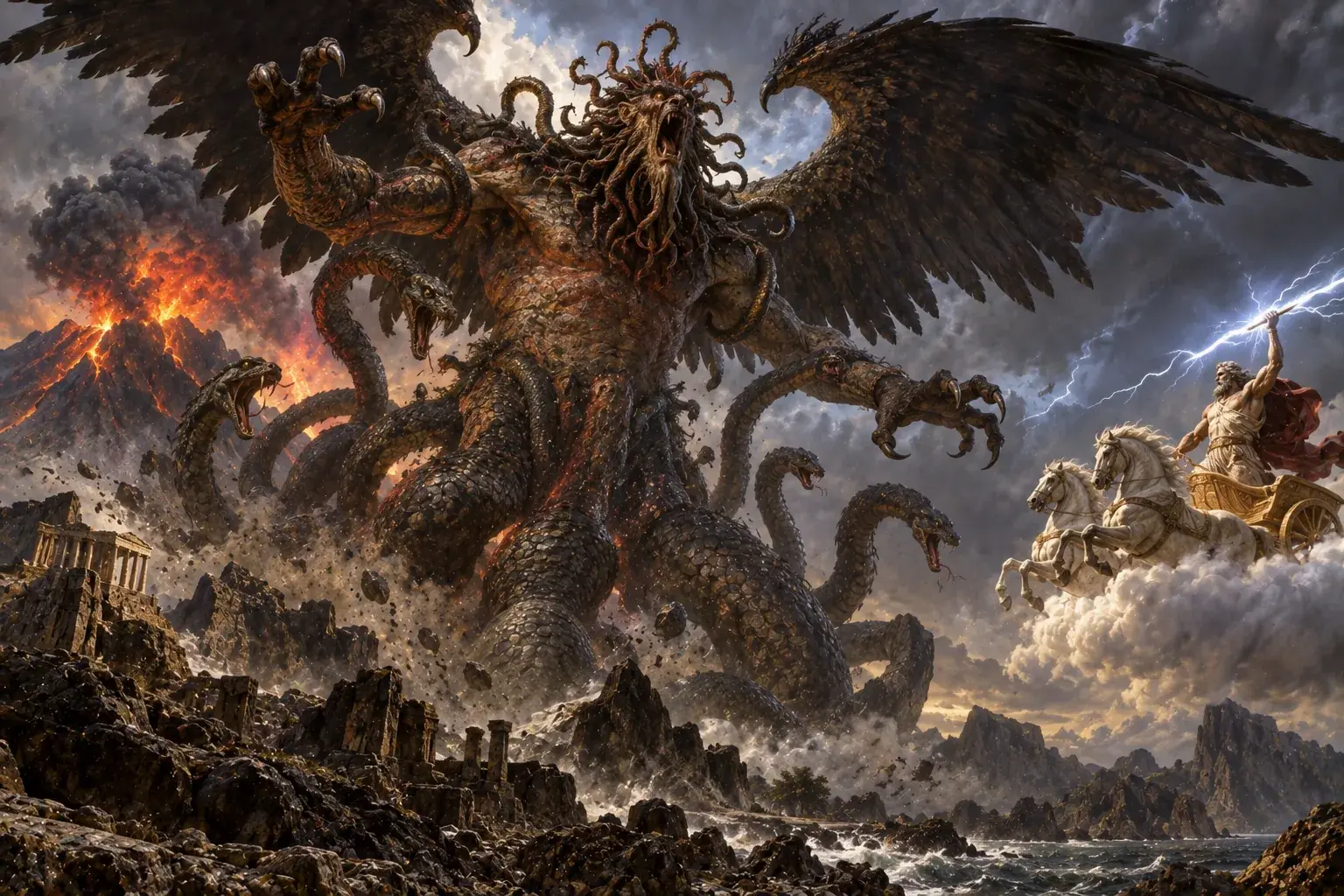
Typhon was the biggest, scariest monster in all of Greek mythology. That's saying a lot, since Greek myths are packed with monsters. There's the Hydra with its many heads, Medusa with her snake hair, and the Minotaur in his maze. But none of them came close to Typhon.
He was so huge that his head brushed the stars. He had snakes where his hands should be, wings all over his body, and fire shooting from his eyes. When he attacked the home of the gods, most of them didn't even stay to fight. They ran.
Typhon was the last great enemy the Olympian gods ever faced. Zeus had already beaten the Titans and the Giants. Typhon was the final test, and he came closer to winning than anyone else ever did.
So who was this monster, where did he come from, and how did Zeus finally stop him? Here's his whole story.
Who Was Typhon in Greek Mythology?
Typhon, sometimes called Typhoeus, was a giant monster who tried to take over the universe. He wanted to rule both the gods and the humans, and he was willing to destroy anything in his way.
The ancient Greeks told his story in many different versions, and the details change depending on who's telling it. But the main plot stays the same. Typhon rose up, scared the gods half to death, fought Zeus in a battle that shook the world, and ended up trapped under a mountain.
He also had a family, and it was a frightening one. Some of the most famous monsters in Greek myths were his children.
Typhon's Appearance: Snakes, Wings and Fire
Ancient writers loved describing Typhon, and each one seemed to try to make him scarier than the last.
The Greek poet Hesiod, who lived around 700 BCE, described him as proud and terrible. He was violent and unbelievably strong. Later, a writer named Apollodorus gave a much more detailed picture. From the waist up, Typhon looked like a man, but a man so tall he stood higher than every mountain. If he stretched out his arms, one hand could reach the far west and the other the far east. Instead of fingers, a hundred dragon heads grew from his arms.
Below his thighs, things got even weirder. His lower body was made of giant, coiled snakes. When they stretched out, they reached all the way up to his head, hissing the whole time. Wings covered his body. Messy, dirty hair blew around his head and face in the wind. And his eyes flashed with fire.
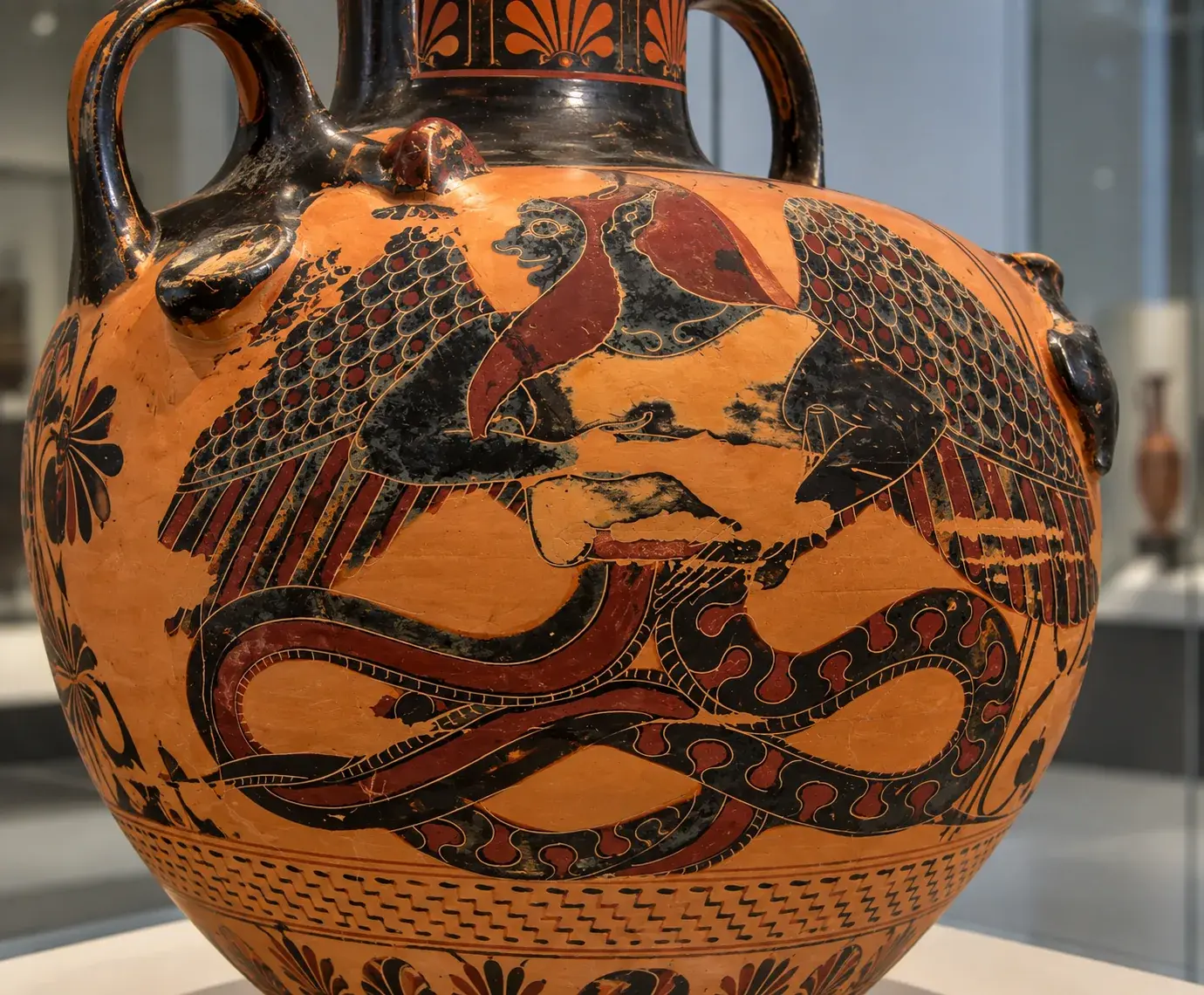
Greek artists often showed Typhon the way Apollodorus described him: human from the waist up, winged, with giant serpent coils below.
The playwright Aeschylus, who wrote plays in ancient Athens, gave Typhon a hundred heads with eyes that glared like flames. Much later, around the 400s CE, a poet named Nonnus went even further. In his version, Typhon was a tangled mass of snakes, with snakes for feet and snakes for hair. Poison dripped from his hair and mouth. He had 200 hands. And his heads weren't all the same. Some were wolves, some were lions, some were boars, and some were bears.
Put all of that together and you get a creature that's hard to even imagine. That was the point. Typhon was supposed to be too big and too terrible for the human mind to handle.
Typhon's Birth: Gaia, Tartarus or Hera
Where did such a monster come from? The Greeks had two very different answers.
In the most common story, Typhon was the son of Gaia, the goddess of the Earth, and Tartarus, the deep, dark pit below the underworld. Gaia had a reason to want a monster. Zeus and the Olympian gods had just destroyed her children, the Giants, in a huge war. Gaia was furious. To get revenge, she had one more child with Tartarus, and she gave birth to Typhon in a cave in Cilicia, a region in what is now southern Turkey.
The second story is found in an old poem called the Homeric Hymn to Apollo, and it's quite different. In this version, Typhon's mother was Hera, the queen of the gods and Zeus's wife. Hera was angry because Zeus had brought the goddess Athena into the world all by himself, without her. So Hera decided to have a child on her own, too, and she wanted one even stronger than Zeus.
She prayed to Gaia, to the sky god Uranus, and to the Titans, asking them to give her a son mightier than her husband. Then she struck the ground with her hand, and she became pregnant. For months she stayed in her temples and accepted gifts from worshippers. When the baby was finally born, it was the cruel and dreaded Typhon.
Hera didn't raise him herself. She handed him over to a dragon named Python. Together, the two of them caused terrible trouble for humans.
Typhon and Echidna's Monster Children
Typhon wasn't alone for long. He fell in love with Echidna, a creature who was half woman and half snake. The Greeks said she was both beautiful and awful to look at.
Together, Typhon and Echidna had some of the most fearsome children in all of mythology. One was Orthos, a two-headed guard dog that belonged to a monster named Geryon. Another was Cerberus, the giant dog that guarded the gates of the underworld for the god Hades. In Hesiod's telling, Cerberus had fifty heads and ate raw flesh.
Their most famous child might be the Lernaean Hydra, the many-headed water serpent. Hera raised the Hydra on purpose because she hated the hero Heracles (the Romans called him Hercules). Later, fighting the Hydra became one of Heracles's famous labors.
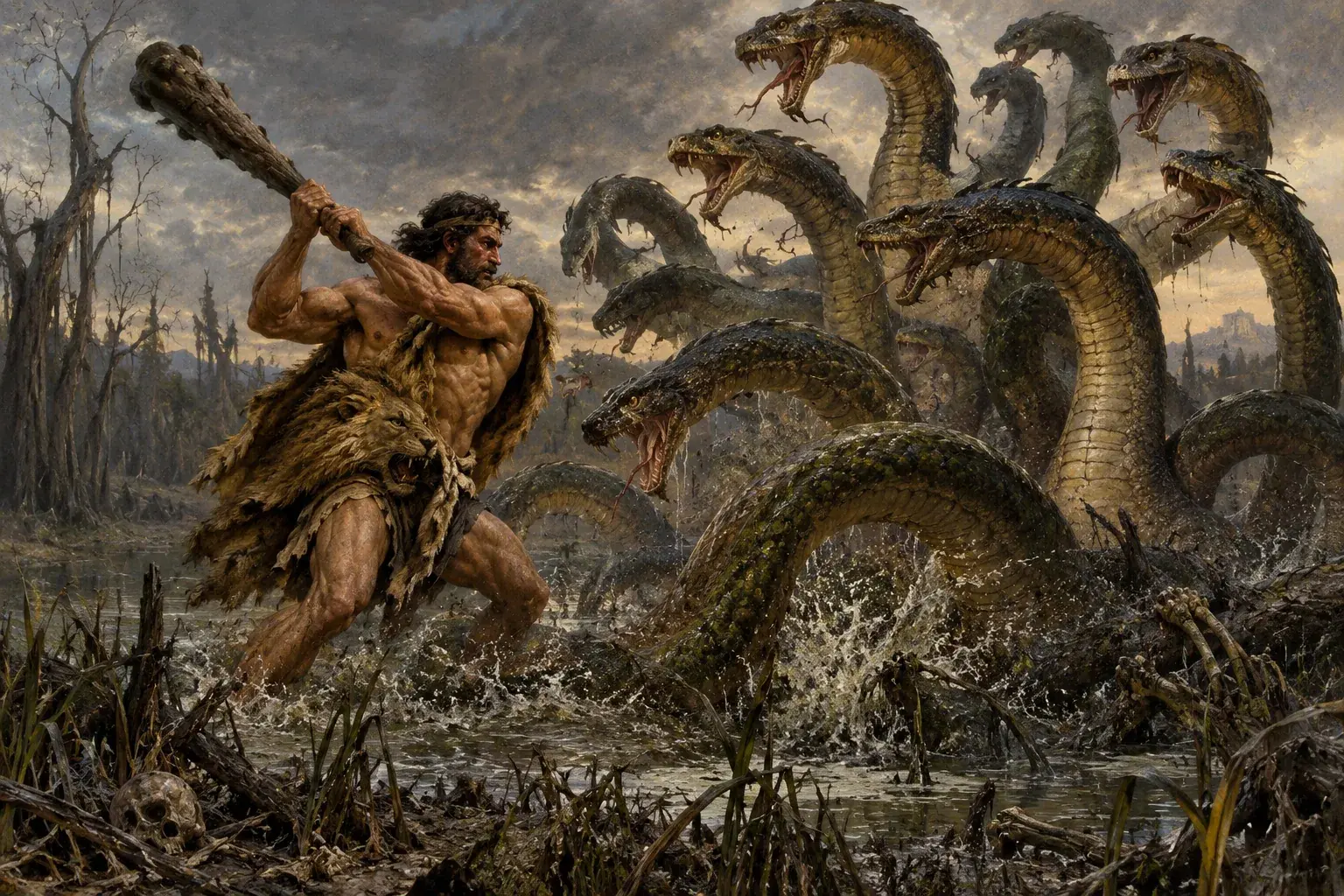
The Lernaean Hydra, one of Typhon and Echidna's children, was raised by Hera to challenge Heracles.
So when you read about Greek heroes battling monsters, there's a good chance you're reading about Typhon's kids.
The Typhonomachy: Typhon's War on Olympus
Like the Titans and the Giants before him, Typhon wanted to rule the heavens. His attack on the gods is known as the Typhonomachy, which basically means "the battle with Typhon." It was the last big fight the Olympians had to win to stay in charge.
Typhon didn't sneak up on anyone. He hurled flaming rocks up at the sky while hissing and screaming his battle cry. Fire poured out of his mouth like a river of lava. Just seeing him was enough to terrify almost anyone, even gods.
The Olympian Gods Flee to Egypt
This is one of the strangest parts of the whole myth. When the gods saw Typhon coming, they didn't grab their weapons. They ran all the way to Egypt.
Typhon chased them there. To hide, the gods changed themselves into animals. Zeus became a ram. Apollo turned into a crow. Dionysus became a goat, and Artemis became a cat. Hera changed into a white cow, Aphrodite turned into a fish, and Hermes became an ibis, a long-legged bird. The exact animals change a bit depending on which ancient writer you read, but the idea is the same. The mighty gods of Olympus were hiding in disguise, hoping the monster would lose track of them.
Some people think this part of the story was a Greek way of explaining something about Egypt. Egyptian gods were often shown with animal heads or animal forms. The myth gave the Greeks a fun reason why.
Zeus, the Stolen Tendons and the Corycian Cave
Not every god hid for good. Zeus eventually decided to fight back.
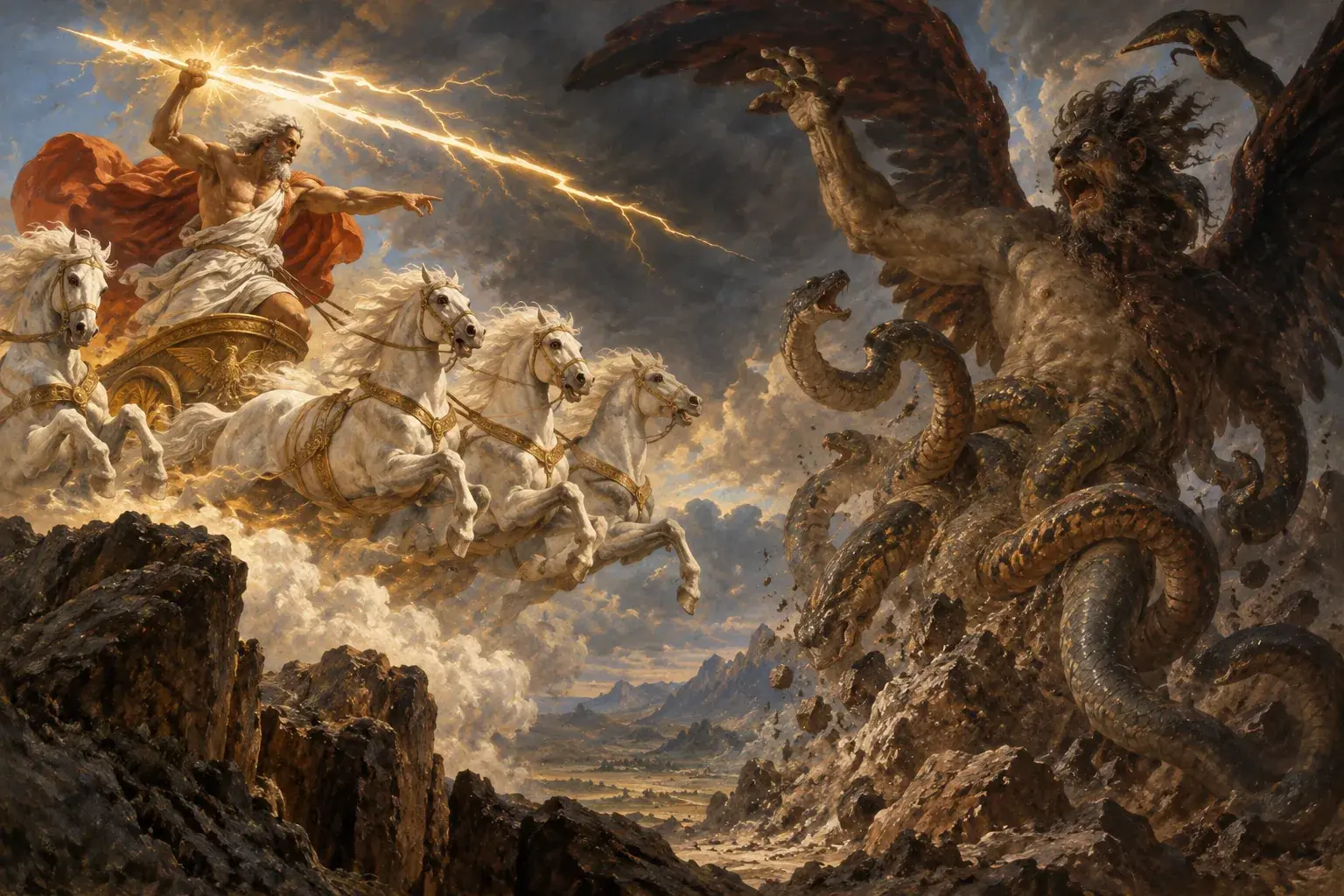
Zeus began the fight with thunderbolts from a distance, but getting too close nearly cost him everything.
At first, he played it safe. He threw thunderbolts at Typhon from far away. As the monster got closer, Zeus attacked with a special curved blade called a sickle, made of adamant, an unbreakable material. He wounded Typhon and chased him to Mount Casion, a mountain near Syria.
Seeing how badly Typhon was hurt, Zeus figured he could finish him off up close. That turned out to be a huge mistake. Typhon was still far stronger than Zeus expected. He wrapped Zeus in his giant snake coils, grabbed the sickle right out of his hands, and used it to cut the tendons in Zeus's hands and feet. Tendons are the tough cords that connect muscles to bones. Without them, Zeus couldn't move.
The king of the gods was helpless. Typhon carried him across the sea and dumped him in a place called the Corycian Cave. He hid Zeus's tendons inside a bearskin and put a guard on them: a she-dragon named Delphyne, who was half woman and half beast.
For a moment, it looked like Typhon had won.
The Fates, Mount Nysa and Mount Haemus
Luckily for Zeus, he had friends. The clever god Hermes teamed up with Aegipan, a wild spirit of the countryside. The two of them sneaked into the cave and stole the tendons right from under Delphyne's nose. Then they put them back into Zeus's body without getting caught.
With his strength back, Zeus was ready for round two. He rode out of the sky in a chariot, carrying his thunderbolts, and went hunting for Typhon.
He found him on Mount Nysa. Typhon had just met the Fates, the three goddesses who control every creature's destiny. They had tricked him. They offered him a taste of some special fruit and promised it would make him even stronger. It didn't. The Fates were quietly on Zeus's side.
When Typhon saw Zeus coming after him again, he fled north to Thrace. Near a mountain called Mount Haemus, the two had another huge fight. Typhon ripped up whole mountains and threw them at Zeus. Zeus answered with thunderbolt after thunderbolt. Soon, blood was streaming from Typhon's body and soaking into the mountain. According to one ancient explanation, that's how the mountain got its name, since the Greek word for blood is "haima."
Mount Etna and Typhon's Prison
Typhon was badly beaten, but he wasn't finished. He tried to escape by crossing the sea toward Sicily. Zeus wasn't about to let him get away. He picked up Mount Etna, a massive mountain on the island of Sicily, and threw it right on top of Typhon.
That ended the battle for good. The monster was trapped underneath, and he's been stuck there ever since.
Mount Etna is a real volcano, and it's one of the most active volcanoes in the world. The Greeks said that every time Etna erupts, it's because of Typhon. The fire comes from his flaming eyes, or from the burning rocks he spits out of his mouth. Aeschylus even added a detail that the blacksmith god Hephaestus set up his workshop on top of the mountain, hammering hot metal right above the trapped monster.
Not every storyteller agreed on where Typhon was locked away, though. Many ancient writers, including Hesiod, said he was thrown into Tartarus, the deepest pit of the underworld. But Homer put him somewhere else, underneath the land of a mythical people called the Arimoi. Hesiod said Echidna lived in that same land.
Typhon and the Egyptian God Set
The Greeks weren't the only ones with a monster like Typhon. Some ancient writers noticed that he looked a lot like a god from Egyptian mythology named Set.
Set was a god of chaos, storms, and violence. The idea that Set and Typhon were basically the same figure goes back to a Greek writer named Hecataeus of Miletus, who lived around 500 BCE. The famous historian Herodotus picked up the idea too.
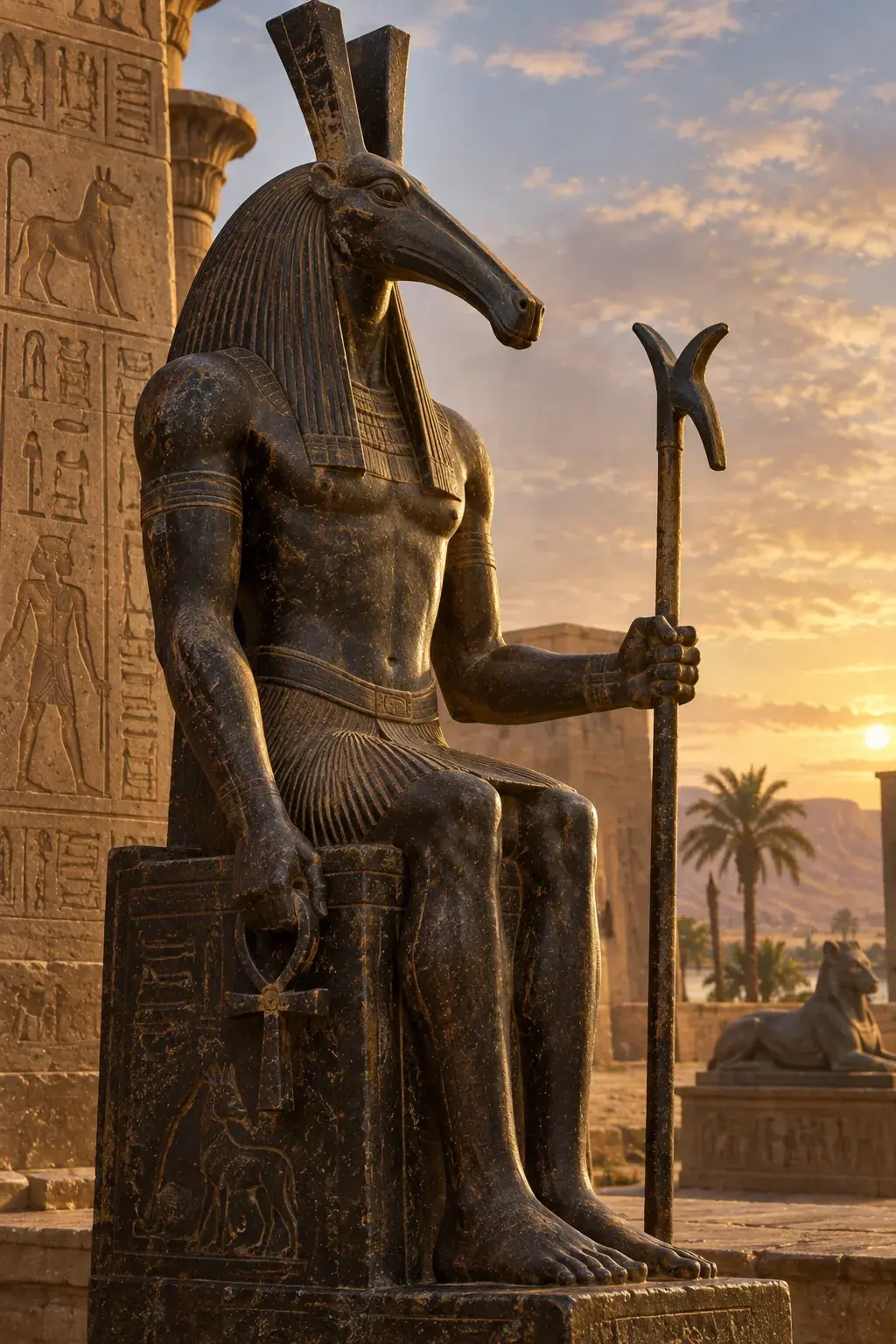
Greek writers from around 500 BCE onward identified Typhon with Set, the Egyptian god of chaos and storms.
Herodotus wrote that, long ago, Egypt was ruled by gods who lived on Earth alongside people. The last of these great gods was Horus, whom the Greeks matched up with their own god Apollo. According to Herodotus, it was Horus who drove Typhon (meaning Set) away.
Herodotus also told a story about a floating island in Egypt called Chemmis. The Egyptians said it floated because the ancient goddess Leto used it to hide Apollo (Horus) when Typhon came searching for the gods in Egypt. He also wrote about a swampy lake called Lake Serbonis, where Typhon was supposedly hidden. Centuries later, the Greek writer Plutarch reported that Egyptians called it "Typhon's breathing hole."
Typhon, Ninurta and Marduk in Near Eastern Myths
Egypt wasn't the only place with stories like this. Myths from ancient Mesopotamia, the land between the Tigris and Euphrates rivers in what's now Iraq, have some surprising things in common with Typhon's tale.
In an old Sumerian poem called Lugal-e, a hissing monster named Azag challenges the god Ninurta for his throne. Ninurta fights back using floods and powerful winds. In a Babylonian story called the Enuma Elish, the god Marduk uses strong winds to battle Tiamat, a goddess of the sea.
See the pattern? A young, powerful god faces a giant, chaotic monster and wins by using the forces of nature as weapons. Zeus has his thunderbolts, Ninurta has his floods, and Marduk has his winds. Many historians think stories traveled between these cultures through trade and travel, and that the Greeks may have borrowed some ideas for Typhon from their neighbors to the east.
Typhon, Volcanoes and Ancient Science
For the ancient Greeks, Typhon wasn't just a scary story. He was also a way to explain real things happening in the world around them.
Volcanoes were a big one. The Greeks didn't know about hot melted rock deep inside the Earth. A giant fire-breathing monster trapped under a mountain made about as much sense as anything else. Some modern writers have even suggested the Typhon myth was connected to the huge volcanic eruption on the Greek island of Santorini thousands of years ago. The people living there fled the island, just like the gods fled from Typhon.
The Greek geographer Strabo, who lived around the time of Julius Caesar, thought volcanic activity in Italy could be explained by Typhon being trapped underground. And the travel writer Pausanias, who explored Greece in the 100s CE, reported seeing statues of Typhon and Echidna near a famous throne in the region of Laconia. Clearly, people didn't just tell stories about Typhon. They carved him in stone too.
Typhon's Legacy: From Monsters to Typhoons
Typhon was trapped under a mountain long ago, but in a way, he never really left.
You might recognize his name in a word you've heard on the news: typhoon. That's what people call a giant, powerful storm in parts of Asia and the Pacific Ocean. Word experts think the English word probably came from a mix of sources, including Chinese and Arabic words, but Typhon's name may have played a part too. It fits. A typhoon is huge, loud, destructive, and almost impossible to stop, which sounds a lot like a certain monster.
Typhon's story also shows up again and again in books, movies, and video games whenever someone needs the ultimate monster. And the basic idea behind it is one you'll find in stories all over the world: order against chaos, with a hero facing an enemy so powerful it seems unbeatable.
Maybe the most interesting part is that, in the end, Zeus didn't win alone. He lost badly at first. He needed Hermes, Aegipan, and even the Fates to help him get back up. Even the king of the gods, it turns out, sometimes needs a little help from his friends.